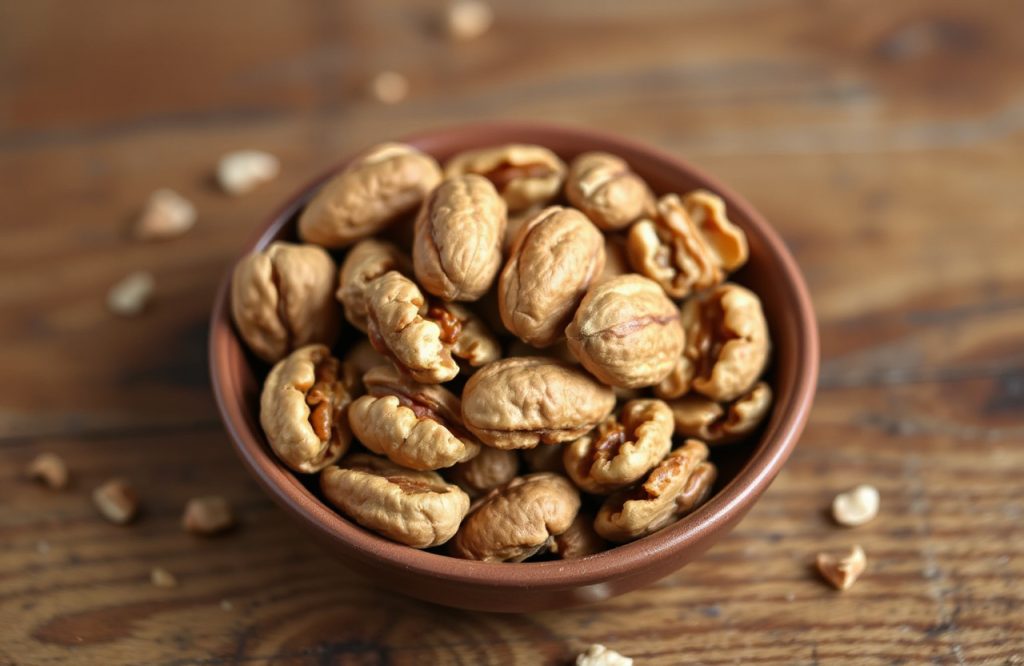
Walnuts and Cardiovascular Health
Study Findings
A recent study suggests that consuming a handful of walnuts daily can enhance cardiovascular health and lower the risk of cardiovascular disease (CVD). CVD remains the leading cause of illness and death globally, with low-density lipoprotein (LDL) cholesterol being referred to as “bad” cholesterol due to its association with increased risks of heart disease and strokes. To mitigate chronic disease risks, experts recommend a diet rich in nutrient-dense foods, including unsalted nuts and seeds.
Nutritional Profile of Walnuts
Walnuts are composed of healthy fats, proteins, and dietary fiber, serving as a significant source of omega-3 fatty acids and α-linolenic acid, both essential for cardiovascular health. The American Heart Association endorses walnuts as a beneficial addition to the diet for increasing omega-3 fatty acid intake, similar to the heart-healthy fats found in oily fish. Regular nut consumption is linked to a 15% reduction in CVD risk and a 23% decrease in CVD mortality rates.
Research on Walnut Consumption
The study published in the journal Circulation analyzed data from the Walnuts and Healthy Aging (WAHA) study, which examined the impact of walnut inclusion in the diet on lipid profiles. A lipid profile assesses lipid abnormalities, including cholesterol and triglycerides, through blood tests.
The study involved 708 healthy elderly participants aged 63 to 79, who were randomly divided into two groups: one following a walnut-free control diet and the other incorporating a half-cup of walnuts daily. By the end of the two-year study, 632 participants completed the trial, during which their cholesterol levels and lipid profiles were evaluated using nuclear magnetic resonance (NMR) spectroscopy.
Results of Walnut Consumption
The study revealed that participants who consumed a half-cup of walnuts daily for two years experienced:
– A reduction in LDL cholesterol levels
– A 4.3% decrease in total LDL particles
– A 6.1% drop in small LDL particles
Co-author Dr. Emilio Ros noted that prior research has linked nut consumption, particularly walnuts, with lower heart disease and stroke rates, attributing this to their ability to reduce LDL cholesterol levels and improve LDL particle quality.
Dr. Ros explained, “LDL particles vary in size, and smaller, denser LDL particles are more closely associated with atherosclerosis, the buildup of plaque in arteries. Our study extends beyond LDL cholesterol levels to provide a comprehensive view of lipoproteins and how daily walnut consumption can enhance cardiovascular risk factors.”
Additional Findings
At the two-year mark, participants in the walnut group showed:
– A 4.3 mg/dL reduction in LDL cholesterol
– An 8.5 mg/dL decrease in total cholesterol
– A reduction in Intermediate Density Lipoprotein (IDL) cholesterol
– A 7.9% reduction in LDL cholesterol for men and a 2.6% decrease for women
Notably, participants did not experience unwanted weight gain despite the high caloric content of walnuts.
Dr. Ros summarized the study’s key takeaway: “Incorporating a handful of walnuts into your daily diet is a straightforward way to support cardiovascular health.”
References
1. Kris-Etherton P. (2014). Walnuts decrease risk of cardiovascular disease: a summary of efficacy and biologic mechanisms. The Journal of Nutrition, 144(4), 547-554. Retrieved from: https://academic.oup.com/jn/article/144/4/547S/4571627
2. Rajaram S, et al. (2021). Effects of walnut consumption for 2 years on lipoprotein subclasses among healthy elders: findings from the WAHA randomized controlled trial. Circulation. Retrieved from: https://www.ahajournals.org/doi/10.1161/CIRCULATIONAHA.121.054051
3. Eating walnuts daily lowered bad cholesterol and may reduce cardiovascular disease risk (2021). EurekAlert! Retrieved from: https://www.eurekalert.org/news-releases/926438