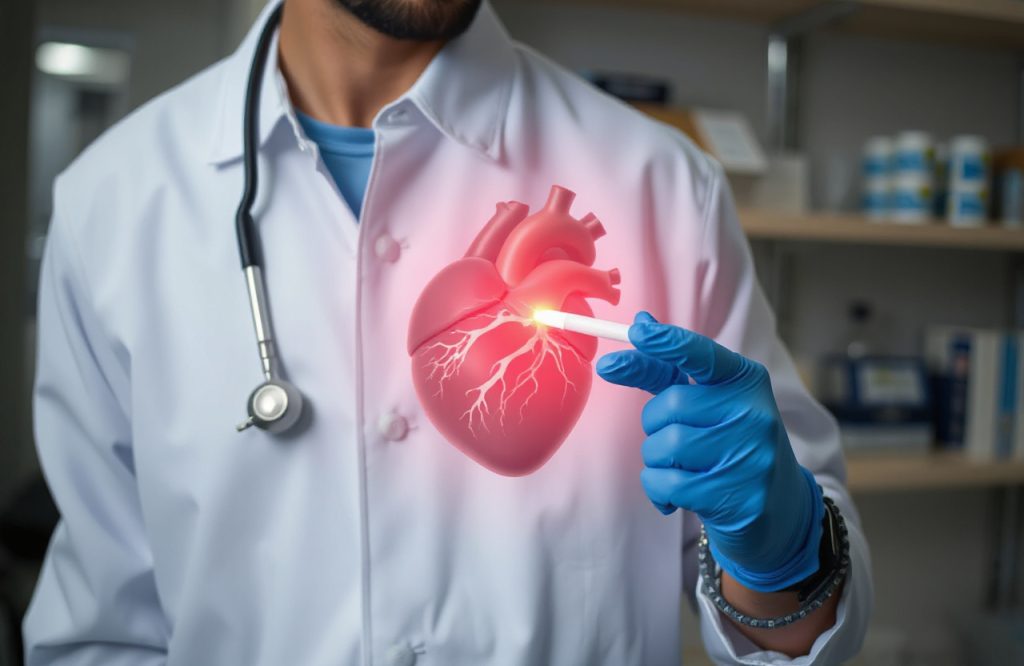
New Needle-Free Test for Heart Disease Detection
Overview of Ischemic Heart Disease
Ischemic heart disease (IHD) is the foremost cause of illness and death in the western world. This condition arises when the blood vessels that supply the heart become narrowed, leading to reduced blood and oxygen flow to the heart muscle. There is a pressing need for innovative and effective diagnostic and prognostic tools for IHD.
Current Diagnostic Techniques
Currently, healthcare professionals employ various methods to diagnose heart disease in hospitals, including stress tests and echocardiography. However, these techniques tend to be non-specific and cannot be solely relied upon for accurate diagnosis. Additionally, myocardial blood flow (MBF)-based methods such as cardiac magnetic resonance imaging (CMR) utilize radioactive substances or other contrast agents. Unfortunately, these imaging techniques carry safety risks and may not be suitable for all patient populations.
Innovative Approach by Researchers
Recently, a group of scientists from Lawson Health Research Institute and Cedars-Sinai Medical Center conducted an international study exploring a novel method to evaluate how effectively the heart processes oxygen. This new technique, known as cardiac functional magnetic resonance imaging (cfMRI), utilizes a breathing machine to expose patients to carbon dioxide repeatedly. This exposure tests the heart’s ability to deliver blood and oxygen effectively.
How cfMRI Works
In healthy individuals, repeated carbon dioxide exposure typically leads to changes in heart blood flow. The cfMRI technique is designed to detect these blood flow alterations and can help identify patients at risk for heart disease when such changes are absent.
Pre-Clinical Testing and Future Applications
The researchers initially applied their cfMRI method in a pre-clinical study involving eight healthy dogs. They are now working on validating its reliability and accuracy for heart disease detection in human patients. A significant advantage of this technique is that it does not require needles, ionizing radiation, or potentially harmful contrast agents.
Given its non-invasive nature, cfMRI can be administered to the same patient multiple times over extended periods, allowing for ongoing monitoring of disease progression and treatment effectiveness. This capability could enable doctors to adjust medications based on individual patient needs.
Potential for Broader Research Applications
Beyond heart disease detection, this method holds promise for other areas of research and medicine. For instance, cfMRI could serve as a research tool to study how various factors, such as chemotherapeutic agents, influence blood and oxygen flow to the heart.
Conclusion
The development of the cfMRI technique represents a significant advancement in the field of cardiac diagnostics, offering a safer, non-invasive alternative for monitoring heart health.
Author Information
Written by Haisam Shah, MSc Candidate
Reference
Yang, H. J., Oksuz, I., Dey, D., Sykes, J., Klein, M., Butler, J., … & Bi, X. (2019). Accurate needle-free assessment of myocardial oxygenation for ischemic heart disease in canines using magnetic resonance imaging. Science Translational Medicine, 11(494), eaat4407.
Image Credit
Image by Gerd Altmann from Pixabay