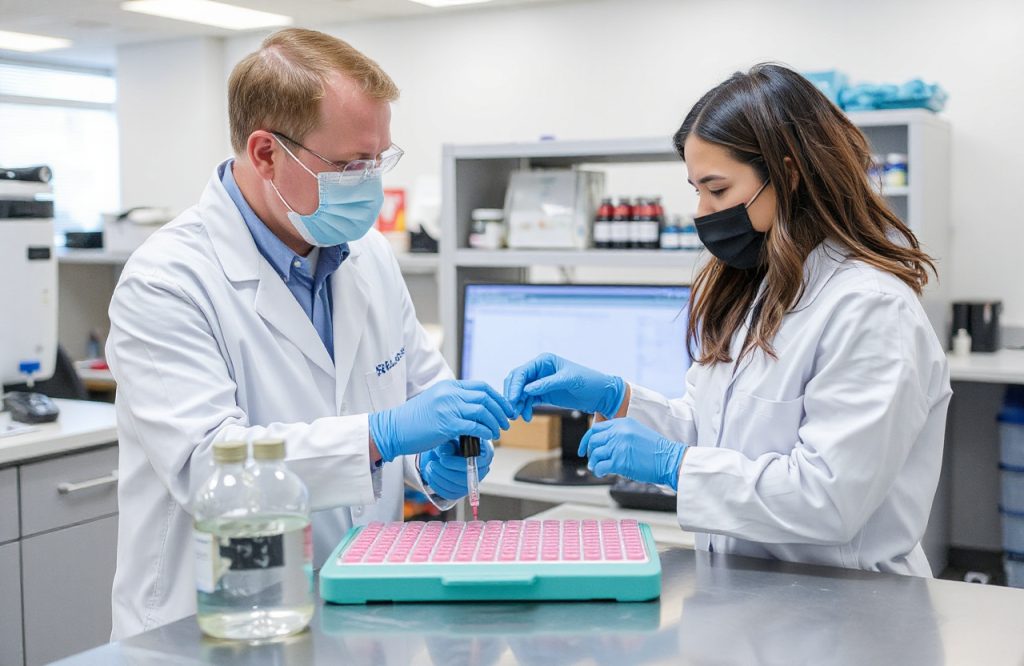
Understanding ELISA Kits in Research and Diagnostics
Precision and reliability are crucial in research and diagnostics for achieving accurate results. Researchers, scientists, and healthcare professionals utilize advanced tools and techniques to detect, measure, and monitor biological molecules. Among these tools, the Enzyme-Linked Immunosorbent Assay (ELISA) stands out as one of the most widely employed methods in laboratories, aided by advanced ELISA kits. These kits are essential for detecting proteins, hormones, antigens, antibodies, and other molecules within samples. The application of ELISA kits extends beyond medical diagnostics, encompassing food safety, pharmaceutical research, and more. This guide aims to deliver comprehensive details about ELISA kits, their types, and applications, providing a clear understanding of their significance in modern science and diagnostics.
What Are ELISA Kits?
ELISA kits are laboratory tools specifically designed to detect and quantify the presence of certain biomolecules, primarily proteins such as antigens or antibodies, in samples. These kits operate by utilizing antibodies that specifically attach to their target antigens. An enzyme linked to this reaction generates a signal, typically observable as a color change, which can be easily measured. For instance, if a researcher needs to determine whether a blood sample contains antibodies against a specific virus, they would use an ELISA kit. The presence of those antibodies would yield a detectable signal, usually measured with a spectrophotometer.
Advantages of ELISA
- Capable of detecting small quantities of substances.
- Uses antibodies that bind specifically to target molecules.
- Applicable to various biological and non-biological samples.
- Facilitates both detection and concentration measurement.
Types of ELISA Kits
ELISA encompasses a range of related methods, each with unique approaches to detecting target molecules, along with specific advantages and limitations. Understanding these differences is essential for selecting the appropriate ELISA kit to achieve accurate results.
Direct ELISA
In a Direct ELISA, the antigen being tested is first attached to the surface of a microplate well. A single antibody, directly linked to an enzyme, is then added. If the antibody binds to the antigen, the enzyme produces a detectable signal, usually indicated by a color change.
- Advantage: Simple and fast, utilizing only one antibody.
- Disadvantage: Higher background noise may reduce accuracy.
- Best for: Quick detection of strong immune responses where high sensitivity is not crucial.
Indirect ELISA
This method involves coating the antigen onto the plate, followed by the addition of an unlabeled primary antibody that binds to the antigen. A secondary antibody linked to an enzyme is then introduced, binding to the primary antibody and generating a signal.
- Advantage: Increased sensitivity as multiple secondary antibodies can bind to one primary antibody, amplifying the signal.
- Disadvantage: Longer process due to the additional step.
- Best for: Measuring antibodies in samples, such as in infectious disease testing.
Sandwich ELISA
The Sandwich ELISA is one of the most widely adopted and reliable methods. It gets its name from the process where the antigen is “sandwiched” between two different antibodies. Initially, a capture antibody is attached to the plate. The sample containing the antigen is then added, followed by a second detection antibody linked to an enzyme. This method allows for the generation of a measurable signal.
- Advantage: Highly sensitive, suitable for detecting minute quantities of a molecule.
- Disadvantage: Requires two high-quality antibodies that recognize different parts of the antigen, making it more costly.
- Best for: Detecting low-abundance proteins such as hormones, cytokines, and growth factors in diagnostics and research.
Competitive ELISA
This method differs from the others by having the sample antigen and a known labeled antigen compete for binding to a limited amount of antibody. A high concentration of the sample antigen will occupy more antibodies, resulting in a lower signal. Conversely, a weaker signal indicates a higher presence of antigen in the sample.
- Advantage: Effective for detecting small molecules that do not easily bind to two antibodies.
- Disadvantage: Result interpretation can be less straightforward since the signal is inversely related to antigen concentration.
- Best for: Measuring small analytes like hormones, drugs, or toxins.
Applications of ELISA Kits
ELISA kits find extensive applications across various industries and scientific disciplines. Some notable applications include:
Medical Diagnostics
- Detection of infections such as HIV, hepatitis, and COVID-19.
- Measurement of hormone levels like insulin, thyroid hormones, and reproductive hormones.
- Monitoring autoimmune diseases through specific antibody detection.
- Identification of cancer biomarkers and other chronic diseases.
Food Safety
- Detection of allergens such as peanuts, milk proteins, or gluten in processed foods.
- Testing for pathogens like Salmonella and E. coli.
- Identifying residues of veterinary drugs, pesticides, and toxins.
Environmental Testing
- Detection of pollutants, toxins, and microbial contamination in water and soil.
- Monitoring harmful algal blooms in marine ecosystems.
Veterinary Medicine
- Diagnosing infectious diseases in animals, including foot-and-mouth disease and avian influenza.
- Assessing immune responses in livestock and pets.
Pharmaceutical and Research Fields
- Drug development processes.
- Quantification of proteins, cytokines, and growth factors in cell culture experiments.
- Quality control during the production of biologics and vaccines.
Conclusion
ELISA kits are among the most reliable and versatile tools available in modern science. By leveraging the specificity of antibody-antigen interactions with the precision of enzyme-based detection, these kits provide accurate and sensitive results. From food safety to environmental monitoring, ELISA kits play a crucial role across various fields. As technology continues to evolve, the capabilities of ELISA kits are expected to enhance, ensuring their relevance in diagnostics and research for years to come.