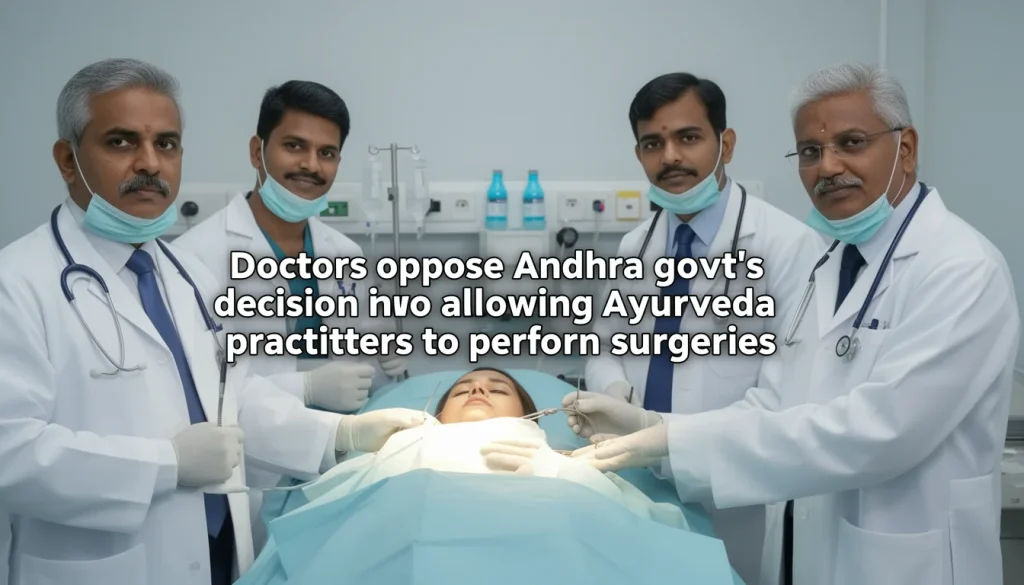
Andhra Pradesh Allows Trained Ayurvedic Practitioners to Perform Selected Surgeries; Medical Community Raises Alarm
Overview of the Government Decision
The Andhra Pradesh government has approved a policy allowing postgraduate Ayurvedic practitioners who have received specified training to independently perform a set of surgical procedures. The move, approved by Health Minister Satya Kumar Yadav, was presented as an effort to integrate the traditional Indian system of medicine with aspects of modern surgical practice. The state framed the permission as being in accordance with the Indian Medicine Central Council (IMCC) guidelines of 2020 and the norms set by the National Commission for Indian Systems of Medicine (NCISM).
medichelpline had earlier reported the development amid a backdrop of opposition from significant sections of the medical community concerned about blending allopathy and Ayurveda for invasive procedures.
List and Scope of Surgeries Permitted
The state has allowed eligible Ayurvedic postgraduate doctors to perform a total of 58 surgical procedures across two traditional specialties:
– Shalya Tantra (general surgery): 39 procedures, including wound debridement, abscess drainage, skin grafting, suturing, treatment of piles, fissures and fistulae, hernia and hydrocele repairs, urological procedures such as circumcision and cystolithotomy, trauma care including reduction of fractures and dislocations, and abdominal emergency surgeries including appendicectomy, cholecystectomy and colostomy.
– Shalakya Tantra (ENT, eye and dental procedures): 19 procedures, including cataract and glaucoma surgeries, correction of eyelid and lacrimal disorders, septoplasty, nasal polyp removal, ear lobe repair, tonsillectomy, tooth extraction and cleft lip repair.
The government’s list identifies specific procedures that the state considers within the remit of postgraduate Ayurvedic training augmented by additional instruction and accreditation.
Concerns from the Andhra Pradesh Branch of the Indian Medical Association
The Andhra Pradesh branch of the Indian Medical Association (IMA AP) has strongly condemned the policy, characterizing the decision as misleading and contrary to scientific principles. In a press note, the association argued that surgical practice is not only a technical skill but a complex clinical discipline requiring comprehensive, standardized training that is provided through MBBS and postgraduate MS/MCh curricula under the National Medical Commission (NMC).
The association warned that permitting cross-practice without equivalent training and accreditation “is neither evidence-based nor ethically justified” and cautioned that any deviation from recognized standards endangers patient safety. IMA AP emphasized that healthcare policymaking should be guided by science, law and patient welfare rather than administrative assurances or political statements, which it said risk eroding public trust in the healthcare system.
National-Level Opposition and Calls for Reconsideration
The IMA headquarters has also expressed opposition to the state’s policy. In a statement, the national body reiterated respect for all systems of medicine and acknowledged the role of Ayurveda in preventive and promotive healthcare, but maintained that performing surgical procedures demands rigorous, structured and specialized training integral to modern medical education.
The national IMA warned that allowing practitioners without equivalent surgical training poses a serious risk to patient safety and could compromise healthcare standards. It urged authorities to reconsider such policies, maintain clear boundaries between different systems of medicine, and prioritize strengthening modern medical training and infrastructure rather than diluting standards. The IMA called for transparent review and stakeholder consultation before implementing measures with far-reaching implications.
Voices from Practicing Physicians and Health Advocates
Several senior medical practitioners and health advocates publicly criticized the decision. Speaking to medichelpline, Dr. Rohan Krishnan, a health activist and Chief Patron of the FAIMA Doctors Association, described the move as “absolutely bizarre.” He emphasized that surgery cannot be imported from another system of medicine by administrative fiat, noting that surgical competence requires years of structured, supervised, hands-on training. Dr. Krishnan stated that the policy amounted to a “dangerous experiment on patients” and warned of risks ranging from uncontrolled bleeding and anesthesia complications to missed diagnoses and delayed referrals.
Dr. Indranil Deshmukh, National Secretary of the IMA JDN Standing Committee, reinforced the need for prolonged, supervised exposure to develop the ability to manage surgical complications and emergencies. He affirmed respect for Ayurveda as a traditional system but said allowing practitioners without formal surgical training comparable to modern standards raised serious patient safety concerns.
Dr. Karan Juneja, Chairman of IMA JDN MSN Gurgaon, urged authorities to consult stakeholders before implementing policy changes and cautioned that permitting surgeries by practitioners lacking required training “would pose a risk to patient safety.”
Legal Context and Next Steps
IMA AP highlighted that the broader question of whether practitioners from Indian systems of medicine can perform surgeries is currently sub judice before the Supreme Court of India. The association noted that the case was filed in 2020, that it was last listed on 04.11.2022, and that the next hearing is scheduled for January 8, 2026. Given the ongoing judicial proceedings, the association argued that state-level assurances or policy statements amount to prejudging matters under active consideration by the courts.
In light of these legal and professional objections, IMA AP has urged the Andhra Pradesh government and the Health Minister to withdraw the statements and refrain from policy commitments that could violate existing laws or interfere with ongoing Supreme Court proceedings. The association has also called for meaningful consultation with recognized medical bodies and warned that it would pursue appropriate democratic and legal remedies at state and national levels if the issue is not addressed responsibly.
Implications for Healthcare Governance
The policy decision has brought into sharp relief tensions between efforts to integrate traditional medicine and the imperatives of standardized surgical education and patient safety. State authorities cite regulatory guidelines under IMCC 2020 and NCISM norms as the basis for allowing certain procedures, while professional medical associations insist on preserving the training standards and legal frameworks that underpin modern surgical practice.
As the debate advances, key actions likely to shape outcomes include stakeholder consultations, review of training and accreditation pathways, and the Supreme Court’s ruling on the matter. Until there is legal clarity and broader consensus among clinical bodies, the controversy is expected to remain a focal point in discussions about the intersection of traditional and modern medical practices.