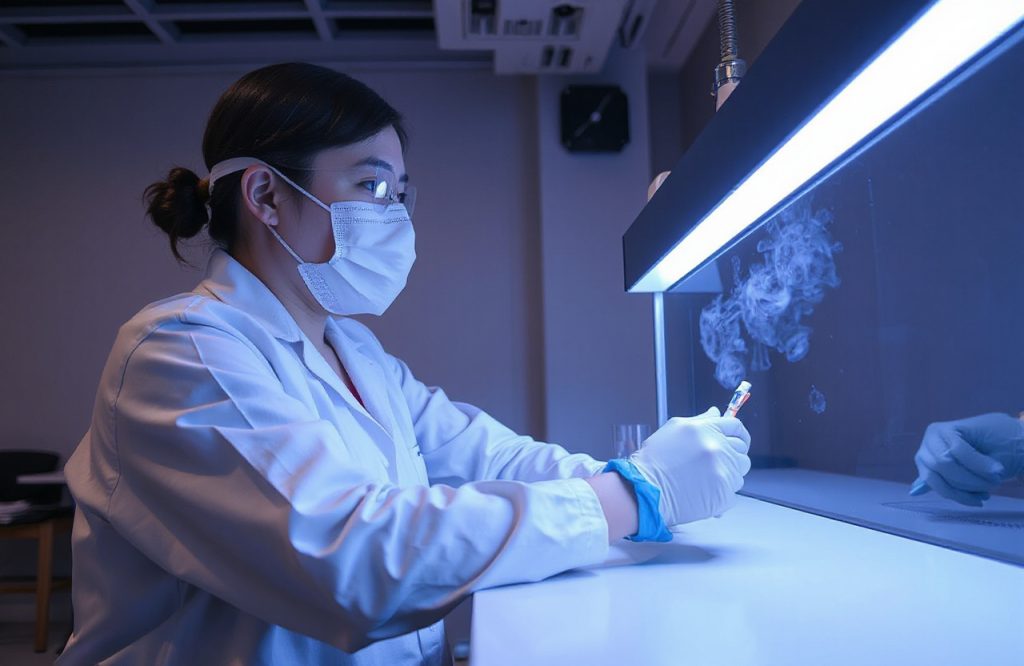
Understanding the SARS-CoV-2 Virus and UV Light Disinfection
Survival of SARS-CoV-2
The SARS-CoV-2 virus can persist on surfaces for up to three days and remain airborne for as long as three hours. This has led to increased interest in using UV light for disinfection during the ongoing pandemic.
Effectiveness of UV Light
Questions arise regarding the safety and efficacy of UV radiation in eliminating viruses and bacteria. The effectiveness of UV light can depend on factors such as proximity to the surface and whether the pathogen is aerosolized.
Types of UV Light
To evaluate UV light’s disinfection capabilities, it is essential to understand the different types of UV radiation:
– **UV-A (320–400 nm)**
– **UV-B (280–320 nm)**
– **UV-C (200–280 nm)**
Shorter wavelengths are more harmful, but UV-C and most UV-B light are largely absorbed by the ozone layer. The UV-A light that reaches Earth’s surface is primarily responsible for skin damage, including sunburn and aging.
UV-C Light for Disinfection
Mechanism of Action
UV-C light has long been employed to disinfect surfaces, water, and air. It targets DNA and RNA molecules, damaging their structure. This inactivation prevents viruses from replicating, thereby blocking potential infections.
Safety Precautions
When utilizing UV light for disinfection, safety precautions are vital. UV-C light can cause severe burns and increase the risk of skin cancer. It poses significant dangers to the eyes, potentially leading to severe, permanent damage.
Research on UV-C and Coronaviruses
Studies on MERS Coronavirus
One study explored the effects of a UV-C disinfection system on the MERS coronavirus, revealing that exposure to UV-C light reduced the virus by over 99% within ten minutes. The researchers emphasized that UV disinfection should complement, not replace, conventional cleaning methods.
Effects on SARS Coronavirus
Another study found that exposure to UV-C light inactivated SARS coronavirus effectively, achieving a 400-fold reduction in infectious virus after six minutes. The maximum effect was noted at the 15-minute mark. However, when UV-C light was applied from a distance of 80 cm, inactivation took up to an hour, suggesting the importance of proximity.
Aerosolized Viruses and UV-C
Researchers also examined UV-C disinfection techniques for aerosolized coronavirus. By simulating respiratory viral aerosols through nebulization, they discovered that 254 nm UV-C radiation effectively disinfected these aerosols. Notably, aerosolized viral particles showed greater susceptibility to UV treatment compared to those in water.
Implications for SARS-CoV-2
While specific studies on UV-C disinfection methods against SARS-CoV-2 are limited, the International Ultraviolet Association asserts that similar results can be anticipated for this virus. Research has focused on using UV light to disinfect masks to facilitate their reuse, particularly important given the current shortages of personal protective equipment.
Conclusion
Prolonging the life of personal protective equipment, such as masks, is crucial during the pandemic. For further information on UV lamps and personal protective equipment, visit www.medofsupply.com.
References
1. N van Doremalen, et al. Aerosol and surface stability of HCoV-19 (SARS-CoV-2) compared to SARS-CoV-1. The New England Journal of Medicine. DOI: 10.1056/NEJMc2004973 (2020).
2. World Health Organization. Ultraviolet radiation and health. Available at: https://www.who.int/uv/uv_and_health/en/
3. Bedell K, Buchaklian AH, Perlman S. Efficacy of an Automated Multiple Emitter Whole-Room Ultraviolet-C Disinfection System Against Coronaviruses MHV and MERS-CoV. Infect Control Hosp Epidemiol. 2016;37(5):598‐599. doi:10.1017/ice.2015.348
4. Darnell ME, Subbarao K, Feinstone SM, Taylor DR. Inactivation of the coronavirus that induces severe acute respiratory syndrome, SARS-CoV. J Virol Methods. 2004;121(1):85‐91. doi:10.1016/j.jviromet.2004.06.006
5. Duan S.-M., Zhao X.-S., Wen R.-F., Huang J.-J., Pi G.-H., Zhang S.-X., Han J., Bi S.-L., Ruan L., Dong X.-P., and SARS Research Team Stability of SARS coronavirus in human specimens and environment and its sensitivity to heating and UV irradiation. Biomed. Environ. Sci. 2003;16:246–255.
6. Walker, CM, Ko, GP. Effect of Ultraviolet Germicidal Irradiation on Viral Aerosols. Environ. Sci. Technol. 2007, 41, 15, 5460-5465. https://doi.org/10.1021/es070056u
7. International Ultraviolet Association. UV Disinfection for COVID-19. Available at: http://www.iuva.org/IUVA-Fact-Sheet-on-UV-Disinfection-for-COVID-19
8. Cadnum JL, Li DF, Redmond SN, John AR, Pearlmutter B, Donskey CJ. Effectiveness of Ultraviolet-C Light and a High-Level Disinfection Cabinet for Decontamination of N95 Respirators. Pathog Immun. 2020;5(1):52‐67. doi:10.20411/pai.v5i1.372
9. Liao L, Xiao W, Zhao M, et al. Can N95 Respirators Be Reused after Disinfection? How Many Times? ACS Nano. 2020; acsnano.0c03597. doi:10.1021/acsnano.0c03597