A Study Merging Ancient Wisdom with Modern Technology
Understanding Solomon’s Paradox
A recent study draws on age-old insights to explore contemporary psychological techniques. In ancient Israel, King Solomon was famed for his wisdom, attracting individuals seeking his guidance. Interestingly, this wisdom often applied more effectively to the problems of others than to one’s own dilemmas. This phenomenon is known as “Solomon’s Paradox,” highlighting how people tend to exhibit greater wisdom when addressing external issues rather than their personal challenges.
The Role of Self-Distancing
Self-distancing is a psychological strategy that arises from Solomon’s Paradox. This technique enables individuals to detach from their emotional burdens and assess their problems from a more objective, external viewpoint. Essentially, it encourages viewing personal issues as if they belonged to someone else.
While self-distancing has proven effective for self-counseling, mastering this technique can be challenging for many patients.
Introducing Virtual Reality as a Tool
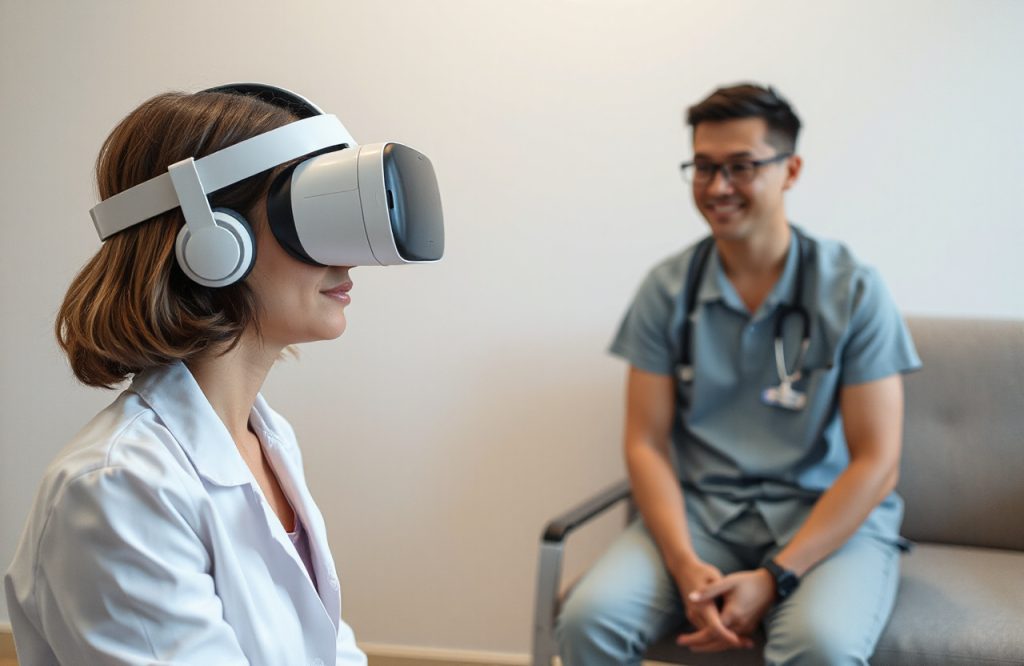
Virtual reality (VR) technology offers a promising avenue to facilitate self-distancing. By creating a realistic virtual avatar that mirrors a patient’s physical appearance and synchronizing its movements with the patient, VR can enhance the experience of self-distancing. Once immersed in their virtual avatar, participants can utilize a body-swapping technique to gain a fresh perspective on their problems.
Virtual Reality Scenarios in the Study
Study Overview
The foundation of this investigation is detailed in a recent publication in *Nature*. The research team developed two distinct virtual reality scenarios. In both scenarios, participants were scanned to create an accurate virtual avatar. This avatar then interacted with a virtual representation of the renowned psychologist Dr. Sigmund Freud. Participants were tasked with articulating their issues to Freud using a standardized structured sentence.
Scenario Descriptions
In the first scenario, referred to as the Scripted scenario (S), the Freud character provided pre-written responses. Conversely, the second scenario, known as the Self-Conversation group (SC), allowed participants to alternate between their virtual selves and the Freud avatar. In this setup, participants would initially express their problems, then switch to the Freud avatar to hear their concerns replayed. Afterward, the Freud character would offer advice, which the participants would then hear again upon returning to their own avatar.
Results and Findings
Self-Conversation Group Benefits
The findings revealed that participants in the self-conversation group reported greater benefits compared to those in the scripted group. Generally, SC participants felt they gained enhanced insight and understanding of their issues, leading to new ideas and improved control. Notably, the intervention influenced the thoughts and feelings of 86% of the SC group, whereas only 48% of the S group experienced similar changes.
Study Sample Characteristics
The study involved a small sample size, with 29 participants in each group. The average age of participants was 21.5 years, and both groups were nearly evenly divided between genders, with 15 women and 14 men. All participants found the VR experience convincing and reported a strong sense of “body-ownership” over both their avatars.
Implications for Future Practice
Will VR Replace Mental Health Professionals?
While this study suggests that VR could aid certain patients in employing self-distancing strategies, it does not indicate that psychologists, psychiatrists, and counselors will soon be replaced by this technology. The research shows VR can assist specific individuals in self-counseling but does not compare this method with other distancing techniques or counseling approaches.
Future Research Directions
Further investigation is necessary to determine which patient demographics would benefit most from VR interventions. Participants in this study underwent screening for psychosis, yet the effects of VR and body swapping may differ for other populations, such as those with paranoid schizophrenia or delusional disorders. Additionally, the younger age of the participants raises questions about the applicability of these findings to older individuals who may be less familiar with VR technology.
Conclusion
Despite these considerations, the study’s outcomes are intriguing and pave the way for future explorations. As virtual reality technology evolves, this research highlights a novel application that could significantly enhance mental health support for a wide range of individuals. Whether utilized for self-counseling or in conjunction with advancements in artificial intelligence, VR holds considerable promise for improving access to mental health care.
Reference
Slater M, Neyret S, Johnston T, Iruretagoyena G, Crespo MÁdlC, Alabèrnia-Segura M, et al. An experimental study of a virtual reality counselling paradigm using embodied self-dialogue. Sci Rep. 2019;9(1):10903.