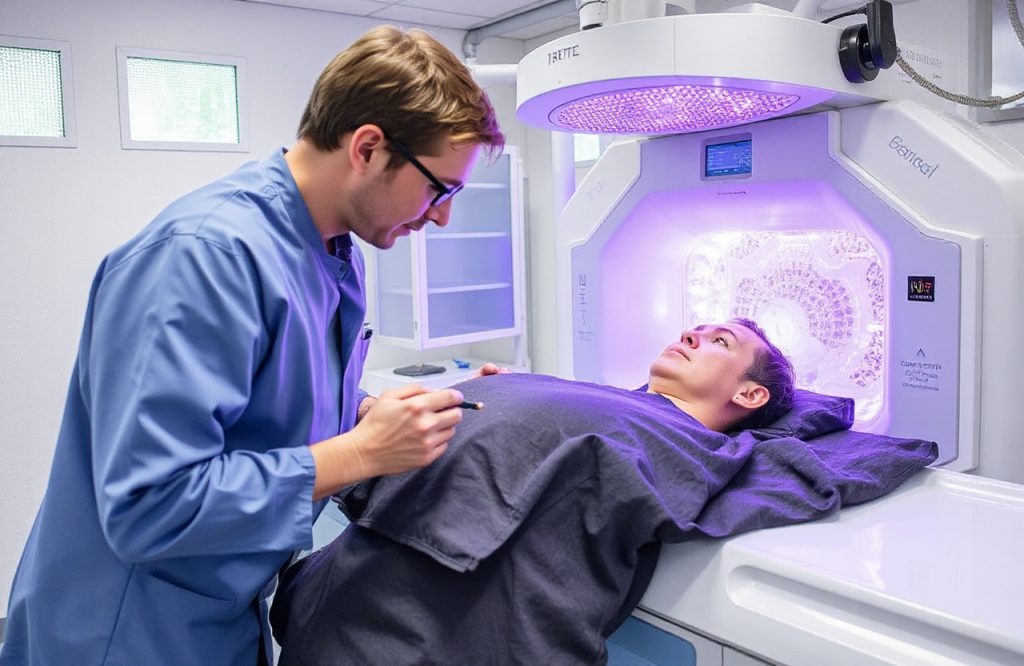
Innovative Treatment for Esophageal Cancer at the University of Maryland
Introduction to Spray Cryotherapy
A groundbreaking treatment for esophageal cancer is currently under investigation at the University of Maryland. This technique, known as Spray Cryotherapy (CRYO), employs extreme cold by applying low-pressure liquid nitrogen directly to the affected tissue. The process involves cycles of spraying and thawing over a 30-minute timeframe, leading to necrosis of cancerous cells and the subsequent regeneration of healthy tissue.
Background and Development
Spray Cryotherapy was introduced in 2007 under the brand truFreeze® by CSA Medical®. This method has demonstrated minimal side effects and remarkable success rates, achieving up to 97% in regenerating cells within the digestive tract of patients diagnosed with Barrett’s esophagus (BE). Barrett’s esophagus is a condition where the esophageal lining is replaced with tissue resembling that of the intestines, often linked to chronic reflux disease and an increased risk of developing esophageal cancer.
Side Effects of CRYO Therapy
Despite its promising results, some side effects have been noted with CRYO treatment in patients with Barrett’s esophagus. These include a 3% occurrence of strictures (narrowing of the esophagus), 2% of patients experiencing severe chest discomfort, and 1% requiring hospitalization due to rectal bleeding.
Research on Safety and Effectiveness
Additional studies have also highlighted the safety and efficacy of CRYO as an endoscopic ablation method, which is used to eliminate unhealthy tissue from the mucosal layer of the esophagus. The current research is focused on applying CRYO therapy to patients with esophageal cancer who are not suitable candidates for standard cancer treatments, including surgery, chemotherapy, radiation, and endoscopic resection.
References
– CSA Medical. “truFreeze.” Available from: http://csamedical.com/trufreeze/. Last accessed: Oct. 4, 2013.
– ClinicalTrials.gov. “Spray cryotherapy for esophageal cancer (ICE-CANCER).” Available from: http://clinicaltrials.gov/ct2/show/NCT01868139?term=cancer&rank=6. Last accessed: Oct. 4, 2013.
– Shaheen, N.J., et al. “Safety and efficacy of endoscopic spray cryotherapy for Barrett’s esophagus with high-grade dysplasia.” Gastrointestinal Endoscopy. 71(4): 680-685. April 2010.
– Virginia Mason: Team Medicine. “Endoscopic ablation therapy.” Available from: https://www.virginiamason.org/EndoscopicAblationTherapy. Last accessed: Oct. 4, 2013.
Additional Reading
– Beauty Products Causing Cancer
– Surgical weight loss more effective at reducing obesity-related cancer and death compared to non-surgical weight loss, new study claims
– Exercise, Omega-3’s, and Vitamin D reduced cancer risk in seniors
– Hormone replacement therapy and cancer: What’s the link?
– How accurate are stool tests for colon cancer?