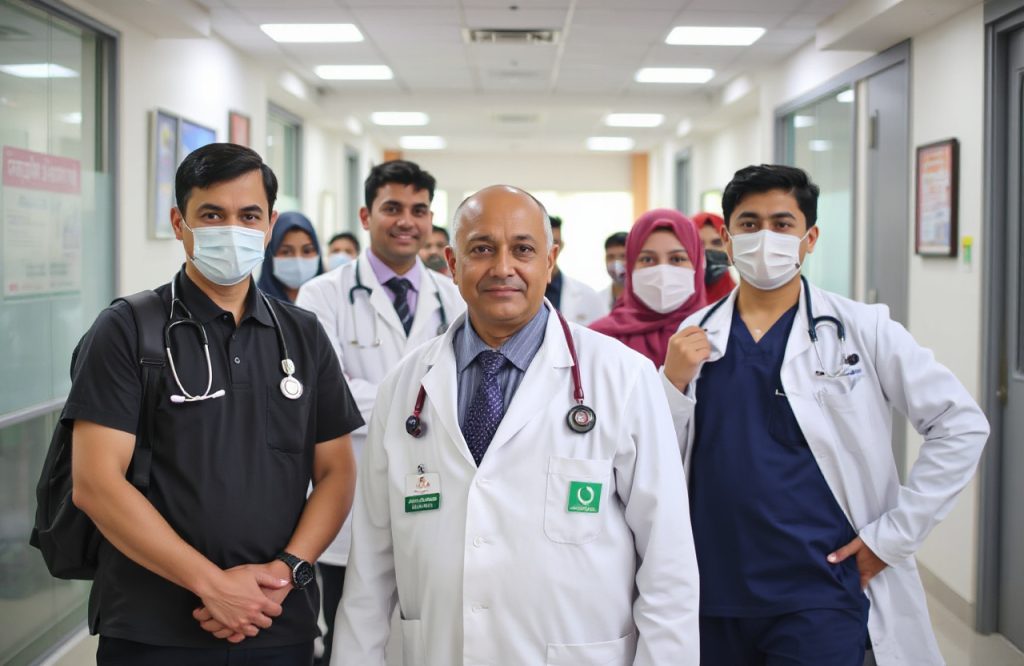
Punjab Health Department’s Policy Upheld by High Court
Overview of the Case
In a recent ruling, the Punjab and Haryana High Court supported the Punjab Health Department’s policy that mandates Punjab Civil Medical Services (PCMS) doctors to complete a minimum of one year of service before enrolling in a postgraduate medical course under the non-incentive category. The court noted that the requirement serves a purpose and is not irrational.
Details of the Ruling
The bench, consisting of Justices Ashwani Kumar Mishra and Rohit Kapoor, made this observation while addressing a petition from a doctor challenging Clause 3.1 in a letter dated June 25, 2019, which was included in the 2025 prospectus. While the justices acknowledged the petitioner’s argument that the ultimate goal is to enhance the quality of doctors within the department, they declined to intervene in the policy. They stated that it falls within the state’s jurisdiction to establish service length requirements, which cannot be deemed irrational simply because an alternative viewpoint exists.
Background of the Petition
The petitioner, who joined the Punjab Government’s medical department after completing the MBBS course, sought to apply for leave to pursue a postgraduate course after working for a month. However, she was denied this leave based on Clause 3.1, which stipulates that PCMS doctors must complete one year of service prior to joining the PG course in the non-incentive category.
Arguments from the Petitioner
The petitioner’s counsel argued that the state failed to provide a rationale for the one-year service requirement, especially since the policy aims to enhance the qualifications of doctors in the PCMS cadre. The counsel also emphasized that as the petitioner was applying under the non-incentive category, she would not receive any salary or benefits while pursuing her postgraduate studies.
Additionally, the petitioner’s legal team contended that the policy ostensibly aims to encourage higher qualifications among MBBS doctors in state employment. Therefore, they argued that the one-year service condition was arbitrary and lacked a clear purpose.
State Government’s Position
In contrast, the State Government defended the policy, stating that the one-year minimum service requirement was implemented to ensure that doctors serve in the PCMS cadre for some time before pursuing higher education. The state noted that many doctors tend to remain in employment for only a short duration before enrolling in postgraduate courses, which was a concern that prompted the policy’s introduction.
High Court’s Perspective
Considering the arguments, the High Court concluded that the policy should be viewed from a broader perspective. It was introduced through a Government Order on June 25, 2019, with the specific goal of ensuring a pool of highly qualified doctors in the PCMS cadre. The court highlighted the distinction between the incentive and non-incentive categories: doctors in the incentive category receive a salary while pursuing their PG studies, whereas those in the non-incentive category do not.
The bench pointed out that while non-incentive category doctors do not receive a salary, they benefit from job continuity, seniority, and other service advantages. The court reasoned that requiring a one-year service commitment from these candidates is justified to prevent potential exploitation of service benefits during postgraduate studies.
Conclusion
Ultimately, the High Court upheld the mandatory one-year service rule for PCMS doctors and declined to interfere with the state’s policy.
To view the order, click on the link below:
Court Order
Related Information
Additionally, readers may find it useful to check the recent notice issued by BFUHS regarding NOC for PCMS in-service candidates for NEET PG 2025.