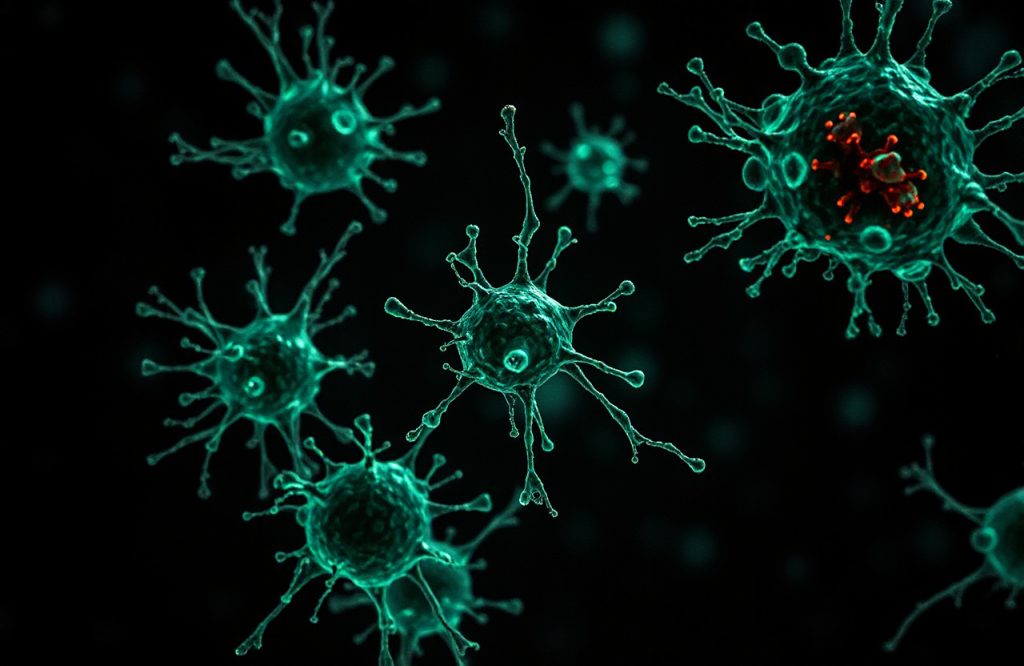
New Therapeutic Molecules Targeting Cancer Stem Cells Discovered
Cancer Stem Cells and Their Role in Metastasis
Recent research has identified a new class of therapeutic molecules that specifically target cancer stem cells, which are linked to metastasis and tumor recurrence. It is important to note that not all cancer cells are identical; various types can coexist within a single tumor. Among these, cancer stem cells are believed to play a crucial role in the spread of cancer and its return following treatment.
Understanding Cancer Stem Cells
Similar to normal stem cells that regenerate tissues and organs, cancer stem cells have the ability to replicate and sustain tumor growth. After surgical removal of a tumor or the application of chemotherapy or radiation therapy, a small population of these stem cells may persist, potentially leading to the development of secondary tumors in distant organs. This phenomenon is often illustrated by the analogy of dandelions in a well-kept lawn—while the visible parts can be cut away, the roots remain, allowing new growth unless specifically targeted.
The Need for Root-Level Treatment
The current objective in cancer treatment is to eliminate cancer at its “root” by focusing on cancer stem cells. This approach not only addresses the tumor itself but also aims to provide a long-term solution to prevent recurrence. Consequently, cancer stem cells have become a focal point in the quest for new anti-cancer drugs.
Breakthrough Research at the University of Toledo
Researchers at the University of Toledo, initially studying enhancements to an existing chemotherapy drug, have potentially made a significant discovery in this area. Dr. L.M. Viranga Tillekeratne, a professor in the Department of Medicinal and Biological Chemistry at the University of Toledo College of Pharmacy and Pharmaceutical Sciences, noted, “At present, there are no drugs that can kill cancer stem cells, but people are looking for them…A lot of drugs are discovered by serendipity. Sometimes in research if you get unexpected results, you welcome that because it opens up a new line of research.”
Findings Published in Scientific Reports
The team’s findings, published in the journal Scientific Reports, highlight a new class of small molecule anti-cancer agents capable of selectively targeting and destroying cancer stem cells. The researchers identified a compound that triggers cell death through a mechanism known as ferroptosis. This process involves the accumulation of reactive oxygen species in the cell, which disrupts the cell membrane’s structure and integrity. Notably, these agents showed the greatest efficacy against a cancer stem cell line.
Funding and Future Applications
To further explore the effectiveness of this newly identified therapy, the researchers have been awarded a three-year grant of $449,000 from the National Institutes of Health. Future research may focus on combination treatments with existing chemotherapy drugs. Additionally, the compound holds potential as a stand-alone treatment for sarcomas and specific subtypes of breast cancer.
Contributors and References
This study was authored by Cheryl Xia, HBMSc. Key references include:
– Taylor, W. R. et al. Small-Molecule Ferroptotic Agents with Potential to Selectively Target Cancer Stem Cells. Scientific Reports 9, 5926 (2019).
– Linkhorn, T. Killing the seeds of cancer: A new finding shows potential in destroying cancer stem cells. EurekAlert! (2019).