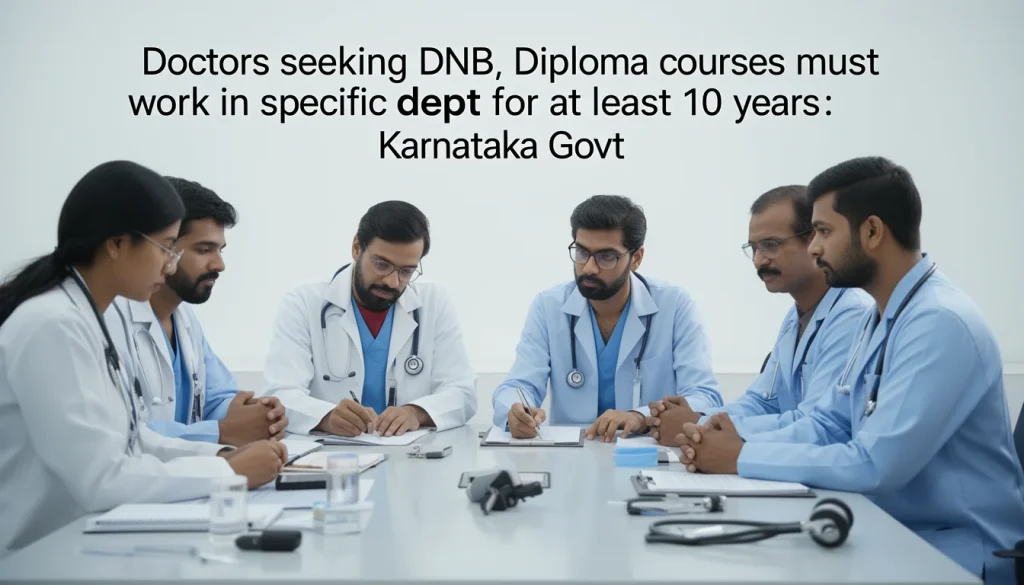
Bengaluru: Health Department issues stricter higher-education rules for government doctors
Overview of the new directive
The Health and Family Welfare Department has published revised guidelines that significantly tighten conditions for government doctors in Karnataka who pursue higher education such as DNB or diploma programmes. The order mandates long-term service commitments in the specific department where the course is pursued and imposes strict compliance measures tied to academic performance. The department has emphasized that failure to meet the specified conditions will attract penalties and other disciplinary measures.
Mandatory 10-year departmental service commitment
Under the new rules, doctors who opt for postgraduate pathways (including DNB or diploma courses) must commit to serving in the corresponding department for a minimum of 10 years. This requirement is intended to ensure that the public health system retains trained specialists and that the state derives sustained benefits from the investment it makes in a doctor’s advanced education.
Before commencing the course, the doctor must provide a written undertaking to the department accepting the 10-year service commitment. The undertaking is a formal prerequisite, and the department will treat it as a binding condition attached to permission to pursue the course while in service.
Academic compliance: logbooks, course completion and NBEMS benchmarks
The department has set clear academic benchmarks that doctors must satisfy to retain benefits and avoid penalties. These include:
– Timely completion of the course within the stipulated duration.
– Proper maintenance of logbooks as part of regular training documentation.
– Meeting the standards and benchmarks set by the National Board of Examinations in Medical Sciences (NBEMS).
Doctors who fail to complete the course within the prescribed timeframe, neglect logbook requirements, or do not meet NBEMS benchmarks will be liable to pay a penalty to the government. The order also states that doctors must submit certificates validating that they meet NBEMS standards in order to be eligible for monthly incentives that may be associated with deputation or in-service training arrangements.
Eligibility for in-service quota or deputation: the seven-year rule
The revised regime reiterates previous clarifications about eligibility for in-service quota counseling or deputation for higher studies. Medical officers seeking permission for either arrangement must have completed a minimum of seven years of government service. This service requirement is composed of two years of probation followed by five years of regular service.
This condition aligns with the Karnataka Civil Services (Deputation for Prosecution of Higher Studies and Training Leave to Group ‘A’ Officers) Rules, 2008, and will be strictly enforced for all future deputation proposals. Under deputation, eligible officers could be sent to pursue higher education during which salary, course fees, and other service benefits may continue, but only when the seven-year condition is satisfied.
Consequences for non-compliance: penalties and enforcement
The Health Department’s order makes clear that strict action will be taken against doctors who fail to meet the academic or service conditions. In specific enforcement action reflected in the recent notices, 208 MBBS graduates who did not sign up for the compulsory rural service in Karnataka have been issued notices by the department. Each of these candidates faces a penalty of Rs 15 lakh if they do not comply with the rural service obligation; they have been given 30 days to remit the penalty, after which legal action is to follow if they fail to pay.
This example illustrates the department’s current readiness to enforce service obligations and financial penalties when contractual or statutory commitments are not met.
Context and departmental intent
The revised rules follow prior controversy and backlash over earlier decisions on higher-education policies for government doctors. medichelpline had previously reported that medical officers seeking higher education would be eligible either for in-service quota counseling during allotment or for deputation to pursue courses with benefits such as course fee support and continued salary. The current order refines and tightens those provisions, emphasizing longer post-training service obligations and more stringent academic compliance.
The department’s stated intent is to balance opportunities for professional advancement with the healthcare system’s need for continuity and retention of trained personnel. By linking incentives and deputation privileges to clear service and academic benchmarks, the Health Department aims to ensure that the public investment in advanced medical training yields sustainable returns for government health services.
What doctors need to do next
Doctors employed by the government who plan to pursue a PG, DNB or diploma course should take the following steps to align with the revised guidelines:
– Prepare to sign the written undertaking committing to a minimum 10-year tenure in the relevant department before course commencement.
– Ensure completion of the course within the stipulated timeframe and maintain accurate logbooks and training records.
– Obtain and submit NBEMS compliance certificates when required to qualify for monthly incentives or deputation benefits.
– Confirm that they meet the seven-year service eligibility before applying for in-service quota counseling or deputation.
Adherence to these steps will be necessary to avoid financial penalties or other departmental actions and to secure the benefits tied to in-service higher education arrangements.
Final note
These measures reflect a clear administrative priority: safeguarding service continuity in government health departments while providing structured pathways for doctors to pursue advanced qualifications. The department’s guidelines emphasize contractual undertakings and measurable academic standards, and they spell out concrete penalties where obligations are not fulfilled. Medical officers and trainees should review these provisions carefully and plan their career moves to remain compliant with the revised rules.