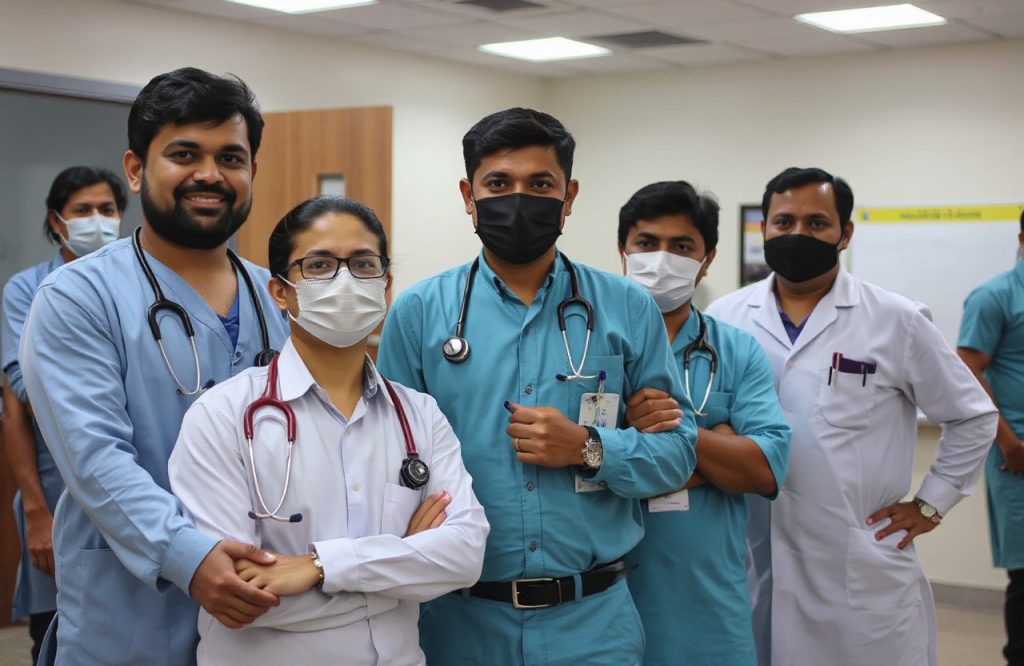
Bengaluru: Protests from Medical Officers Over Postgraduate Course Restrictions
Background of the Protest
Medical officers in the Karnataka Health Department are voicing their concerns regarding the restrictions imposed by the government for pursuing postgraduate medical courses under the in-service quota. This year, the government has mandated that medical officers can only select from six branches for Doctor of Medicine (MD) or Master of Surgery (MS) courses and nine branches for Diplomate of National Board (DNB) courses.
Government Regulations on Course Selection
To address discrepancies between departmental staffing needs and doctors’ preferences, the government specified that in-service officers could only pursue MD/MS courses in six designated branches. These include emergency medicine, traumatology and surgery, critical care medicine, forensic medicine, anesthesia, and family medicine. Consequently, those interested in other subjects under the in-service quota will not be granted deputation. A number of medical officers have since challenged this decision in court.
Limited Options and Consequences
According to a report by the Times of India, due to the limited selection of courses, the majority of medical officers—except for a few—applied and were allotted only DNB seats during the recent Karnataka Examinations Authority (KEA) mock allotment. One medical officer who received a DNB seat expressed frustration, stating, “Doctors from departments like Greater Bengaluru Authority (GBA) or ESI were allotted MD or MS seats even under different branches, but not us.”
Concerns About Quality of Education
The officer further articulated concerns about the quality of education in DNB programs, indicating that these are often conducted in taluk or district hospitals, which may not provide sufficient exposure to complex cases. “The quality of education will be very different in medical colleges under National Medical Council (NMC) norms. We will learn more in medical colleges, but with DNB, we will rarely see any complicated, serious cases,” he added.
Questioning Staffing Logic
The officers have raised questions about the staffing logic behind the selection constraints. Another medical officer noted, “Under DNB, there are options like obstetrics & gynaecology, paediatrics, and orthopaedics. Does that not mean there is a need for such specialists in the health department? Then why are we not being allowed to pursue them as a master’s course, which is of higher quality anyway?”
Karnataka Government Medical Officers Association’s Stance
The Karnataka Government Medical Officers Association (KGMOA) criticized the preference for DNB over MD/MS seats. An anonymous office bearer commented, “For almost 30 years, in-service quota has been provided. Why suddenly bring in these rules? They are taking away doctors’ freedom of choice by restricting the branches.”
Government’s Justification
In response, the Health Department defended its stance, emphasizing that its needs assessment is focused on primary care rather than tertiary specialties. Harsh Gupta, the Principal Secretary of the Health Department, explained, “What we currently need in our PHCs, CHCs, and taluk hospitals are doctors specialized in family medicine or emergency care. Our requirements differ from those of tertiary hospitals.”
Clarification on DNB and MD/MS Programs
Gupta further noted that DNB programs do not deplete human resources for three years, unlike MD/MS programs. He stated, “DNB is an equivalent course, and officers will gain clinical exposure as they will encounter similar cases in their daily practice, as they do during the course.”
New Rules for In-Service Doctors
Earlier this year, the Karnataka Government established new regulations that tightened the rules for in-service doctors wishing to pursue postgraduate medical courses. These rules specify that Karnataka-based medical officers can either utilize the in-service quota during counseling or be sent on deputation for higher education, during which they would be eligible for course fees, salary, and other benefits.
Eligibility Criteria for In-Service Quota
Additionally, the new regulations state that medical officers must complete a minimum of seven years of government service to qualify for the in-service quota or deputation for postgraduate or DNB courses. General Duty Medical Officers are eligible after completing six years of service. The rules also clarify that the in-service quota and/or deputations will not be permitted for super-specialty courses.