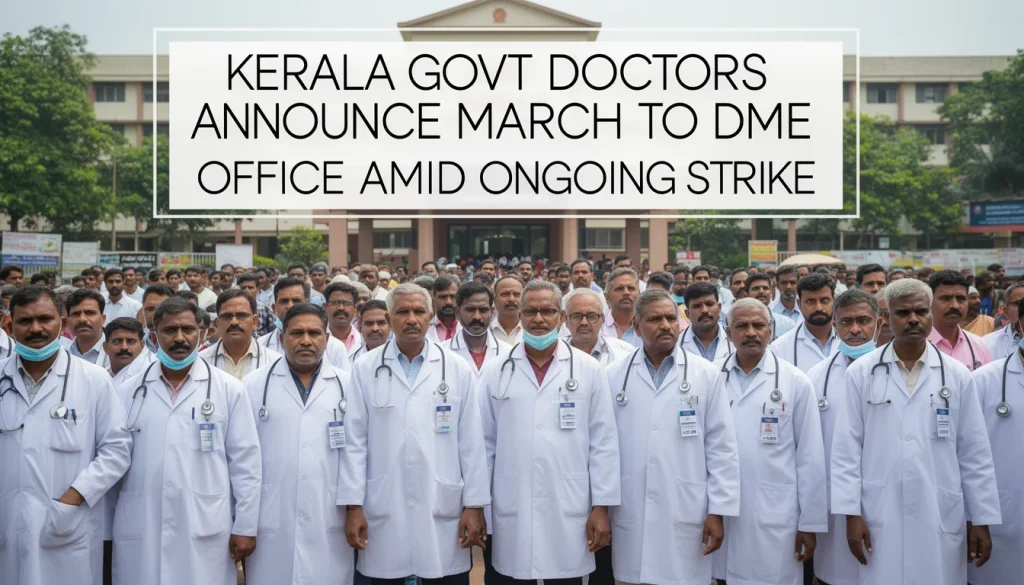
Kerala government medical college doctors plan march to DME amid intensifying strike
Summary of the protest and planned action
Government medical college doctors in Kerala have announced a march to the Director of Medical Education (DME) office on Monday, alleging that authorities are attempting to suppress their ongoing indefinite agitation. The Kerala Government Medical College Teachers’ Association (KGMCTA) issued a statement saying it will intensify the strike to press for resolution of long-standing grievances concerning service conditions and pay anomalies affecting medical college faculty. KGMCTA state president Dr Rosnara Begum is named in the association statement as leading the call for the march.
Current status and chronology of the agitation
The agitation has unfolded over several weeks and escalated into multiple coordinated actions by medical college doctors. medichelpline recently reported that the strike had reached its 30th day at one point; the KGMCTA later said the hunger strike had entered its 33rd day. Parallel actions reported by the association include a sustained boycott of outpatient (OP) services and academic duties — which the association stated had entered its 12th day — and a cessation of non-emergency surgeries, ongoing for eight days. Earlier reports within the course of the protest described the OP boycott and academic duty withdrawal as having completed nine consecutive days; these varying day counts reflect the progressive intensification of the action over time.
Allegations against the DME and administrative pressure
The KGMCTA alleges that, rather than proactively engaging to settle the dispute, the DME has sought to pressure hospital principals, heads of departments and individual doctors to terminate the strike. The association characterizes these measures as attempts to suppress the agitation instead of taking leadership in resolving the issues raised by medical college faculty. These assertions were presented by the association in its public statement and were reported to medichelpline.
Planned administrative withdrawals and mass resignations
As part of the escalation, doctors in government medical colleges have resolved to relinquish additional administrative roles they currently hold beyond teaching and patient care. The association said it will submit a college-wise list on Monday to the DME identifying posts to be vacated — positions that include hostel wardens, nodal officers and academic coordinators. The KGMCTA also indicated that mass resignations from such additional posts will be tendered as a collective step to press for redress of their demands. The association framed this withdrawal of extra responsibilities as a necessary means to underline the seriousness of the faculty’s grievances.
Impact on patient care, surgeries and medical education
According to the KGMCTA, the strike has significantly disrupted routine functioning at government medical colleges. Patient footfall at outpatient departments has reportedly fallen sharply, with postgraduate students currently managing outpatient services in many institutions. The association stressed that the combined impact of the hunger strike, OPD boycott, suspension of academic work and the halt to non-emergency surgeries has placed considerable strain on patients and students. Clinical services, inpatient care, elective procedures and academic schedules have all been affected, creating hardships for those who rely on public medical college services and for the medical students whose training is being interrupted.
Negotiations, legal advice and the government stance
The association has said that discussions intended to resolve the matter — discussions it understood would be led by the finance minister — have not proceeded as expected, with authorities reportedly reneging on earlier commitments to hold talks. KGMCTA members state that legal advice was received on February 13, but that the finance department has not issued a final decision on the matters raised. While the government has acknowledged that the demands of medical college doctors are legitimate, officials have maintained that they are currently unable to address those demands — a position the association says it cannot accept. These points are presented as the association’s account of the negotiation status and the administrative response.
Association profile and rationale for escalation
The KGMCTA represents faculty and service-level doctors in government medical colleges across the state and is regarded as an influential organization within the public medical education system. The association frames its intensified action — including the planned march to the DME, mass relinquishment of additional posts and continuation of the hunger strike — as a last-resort effort driven by the absence of concrete remedial steps from the government. Its leaders argue that, given the significant impact on services and the perceived inaction by administrative authorities, strengthening the agitation is the only available option to compel resolution.
What to watch next
The immediate developments to monitor include whether the scheduled march to the DME office proceeds as announced, whether the DME responds substantively to the list of administrative posts to be relinquished, and whether the finance department takes a final decision following the reported legal advice. The trajectory of the strike — particularly any escalation or de-escalation of service boycotts and academic disruptions — will directly affect patient care and medical education in the affected institutions. medichelpline will continue to report further updates as parties respond and negotiations evolve.