Kerala government doctors postpone protest as talks with administration continue
Protest meeting rescheduled amid ongoing negotiations
The Kerala Government Medical College Teachers’ Association (KGMCTA) has deferred a planned protest meeting from Monday to Wednesday while discussions with state authorities continue. The association has been staging a prolonged agitation over unpaid salary arrears and unresolved issues related to service conditions for medical college faculty. Negotiations remain active, and officials have indicated another round of talks is expected midweek.
A meeting that had been scheduled with the Additional Chief Secretary of the Health and Family Welfare Department, Dr. Rajan N. Khobragade, did not take place on Monday. Association leaders say they anticipate further engagement with senior officials on Wednesday to seek progress on the outstanding demands.
Where the dispute stands: cleared files but no final decision
KGMCTA leaders report that the administrative machinery has taken several procedural steps: files approving the release of salary arrears have reportedly received clearance from senior officials in the Finance, Health, and Law departments. According to the association, these files have reached the finance minister on two separate occasions but a final decision or disbursal has not followed.
In a joint statement, state president Dr. Rosnara Beegum T and general secretary Dr. Aravind C S told medichelpline that the chief minister had assured doctors he would raise the matter with the finance minister. Despite that assurance, the association says there has been no further update communicated to its members, prompting appeals for direct intervention from the chief minister to expedite a resolution.
Association’s demands and proposed escalation
Core grievances: arrears and service-condition reforms
The KGMCTA’s central demands focus on the immediate release of pending salary arrears owed to government medical college faculty and corrective measures to improve service conditions. While the association characterizes the current discussion as constructive, leaders emphasize that tangible action and timelines are needed to rebuild trust and restore normal functioning within medical colleges.
The association has also highlighted the broader objective of strengthening hospital standards — an issue they say is linked to timely and fair settlement of pay anomalies and clear resolution of service-related grievances.
Steps threatened if talks fail
KGMCTA leaders have warned that, absent government action, they will escalate their agitation. The escalation would begin with the relinquishment of all additional responsibilities handled by the faculty beyond their clinical and teaching duties. Specifically, doctors have threatened to step down from roles such as nodal officers and project coordinators — positions that support coordination of projects and administrative oversight within medical institutions.
The association frames this as a calibrated measure designed to increase pressure while highlighting how prolonged inaction could affect hospital administration and project continuity. While the association has not described beyond these steps, they underscore that further intensification of the agitation remains an available course of action.
Planned demonstrations and recent developments
March to the Director of Medical Education
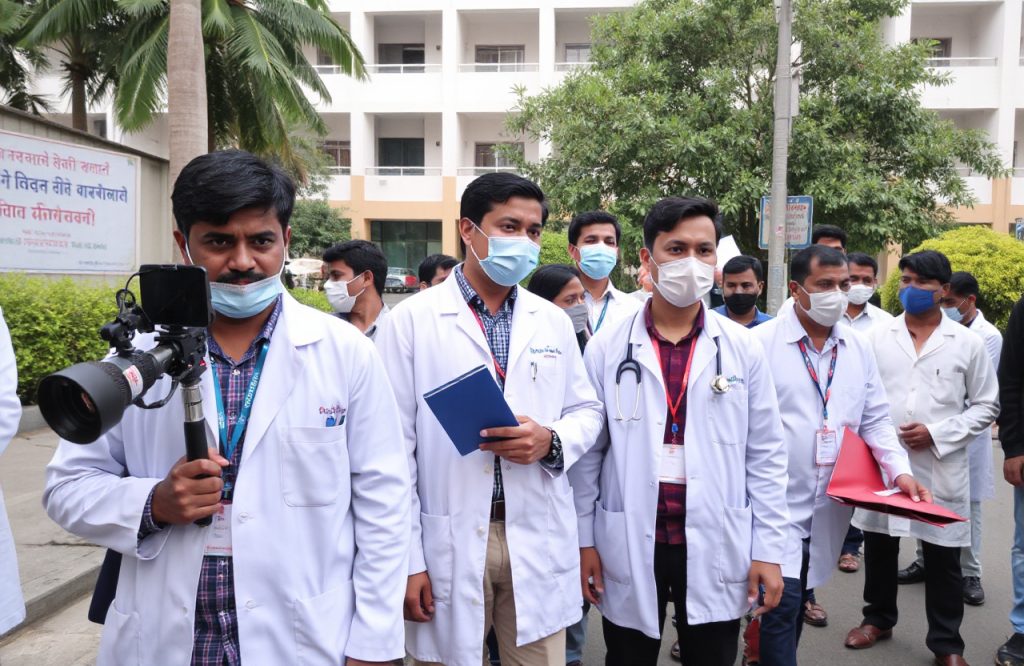
In a statement issued ahead of the rescheduled meeting, KGMCTA announced plans for a march to the office of the Director of Medical Education (DME). The march was described by association leadership as a protest against what they perceive as attempts by authorities to suppress the agitation instead of actively seeking settlement measures. The rescheduling of the protest meeting reflects the association’s decision to keep dialogue open while maintaining visible pressure through organized demonstrations.
Context: hunger strike and service disruption reports
medichelpline had earlier reported that a hunger strike by medical college doctors entered its 30th day, with reports that patient services were being disrupted as a consequence. That earlier escalation underscores the depth of frustration among faculty and the sustained nature of the dispute. Association leaders say their intensification measures are intended to obtain timely redressal rather than prolong confrontation, stressing that a mutually agreeable settlement would be preferable to further disruption.
What to expect next
Wednesday talks and possible outcomes
With talks slated to resume on Wednesday, stakeholders will be closely watching for concrete outcomes: formal approval for salary disbursement, a clear timeline for payments, and commitments on corrective steps to address service-condition anomalies. KGMCTA has emphasized the need for an authoritative response from the finance ministry or the chief minister’s office to translate cleared files into action.
If the administration provides firm assurances and a schedule for implementation, the association may suspend escalation plans. Conversely, if discussions again yield no definitive decision, KGMCTA has indicated it will proceed with relinquishing additional institutional responsibilities and continue demonstrations to press its demands.
Implications for patients and institutions
The dispute highlights the interplay between administrative processes and front-line medical services. Prolonged agitation and administrative vacancies in nodal or coordinating roles can affect project delivery and institutional functioning. Association leaders frame their measures as a last resort to compel resolution, while calling on the government to act promptly to prevent further disruption to both staff welfare and patient care.
The evolving situation will hinge on the outcomes of the forthcoming meetings and any subsequent directives from the finance and health departments. medichelpline will continue to monitor developments and report on formal resolutions or further actions announced by the association or the government.