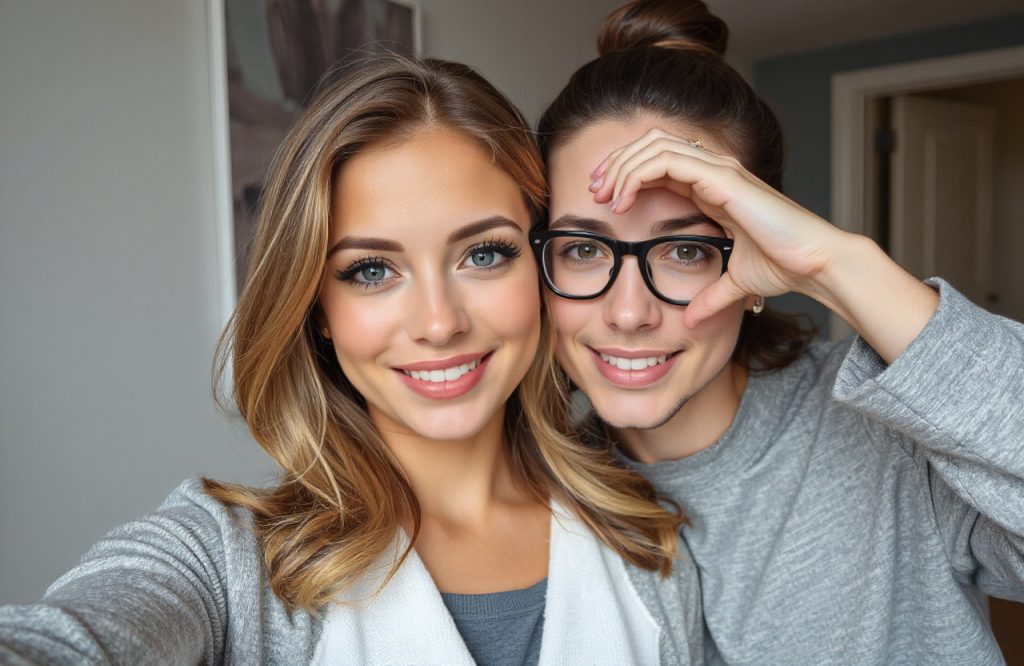
New Study Investigates Innate Preferences in Taking the Perfect Selfie
The Quest for the Ideal Selfie
How do we take the perfect selfie? This question has intrigued people since the advent of camera phones. A recent study published in the journal PLOS ONE delves into a theory suggesting that humans may possess a subconscious preference for eye positioning in portraits and self-portraits. This theory builds on the observational research of CW Tyler, who found that artists throughout history often place one eye slightly above the center of a portrait.
Debate Surrounding Eye-Centring Theory
Despite Tyler’s findings, the concept of eye-centring has faced skepticism. Critics argue that it may reflect a statistical necessity rather than a conscious preference. When artists capture a large object, such as a person’s head, within the confines of a small frame, one eye is likely to fall near the center due to its prominent placement on the face.
Adding to this complexity is the phenomenon known as “pseudoneglect,” where individuals tend to misidentify the center of an image, often selecting an area to the left of the actual center. If there exists a tendency to center one eye, and considering this misidentification, one might expect a preference for positioning the eye slightly left of center.
Previous Research Findings
Earlier studies investigating this concept found no strong evidence supporting eye-centring. However, the selfies analyzed in those studies were not spontaneous; they were taken specifically for research purposes. In contrast, the current research team posits that genuine selfies from untrained individuals do exhibit an eye-centring bias.
Methodology of the Current Study
To test their hypothesis, the researchers utilized a publicly available online dataset containing approximately 4,000 selfies from six cities worldwide. They filtered out images that did not meet their criteria, such as group selfies or portraits not taken by the subjects themselves, resulting in a final pool of 3,556 selfies.
For each image, the researchers calculated the horizontal center (the midpoint between the left and right borders) and measured the distance from each eye to this center, recording the smaller of the two distances. To standardize the distances, they assigned values to the horizontal center as zero, the left border as -0.5, and the right border as +0.5. This allowed for the calculation of the relative distance of each eye from the horizontal center.
Results and Implications
The analysis revealed a significant tendency for the most centered eye to be positioned at or very close to the horizontal center of the image. This trend was consistent across various factors, including the sex of the selfie taker, the type of selfie, and the city of origin. A small but statistically significant preference for centering the left eye over the right was also noted.
Additionally, the researchers conducted statistical analyses to determine if the observed distribution could be attributed to random chance, as critics of the eye-centring hypothesis suggested. The results indicated that the findings were unlikely to be due to statistical inevitability.
Conclusion and Future Research Directions
The outcomes of this study lend support to the notion of subconscious eye-centring and align with the theory of pseudoneglect, evidenced by a slight leftward bias. Interestingly, individuals from six diverse cities exhibited this tendency without any awareness or formal training in photography. However, the research does not delve into the reasons behind this behavior, highlighting a potential area for future exploration. For now, the study offers practical advice for selfie enthusiasts: consider positioning your eyes slightly left of center for optimal results.
Reference
Bruno N, Bertamini M, Tyler CW. Eye centring in selfies posted on Instagram. PloS one. 2019;14(7):e0218663.
Image by Luis Wilker Perelo WilkerNet from Pixabay.