Faridabad Doctor Linked to Deadly Explosion
Incident Overview
A doctor driving a Hyundai i20 that exploded near the Red Fort in Delhi recently has emerged as a key suspect in a terror module. The explosion resulted in the deaths of at least eight individuals and injured approximately 20 others. Authorities believe this doctor may be the leader of a “white-collar group” of medical professionals involved in planning the blast.
Background of the Suspect
The doctor relocated to Faridabad about a year and a half ago and served as an Assistant Professor at Al Falah School of Medical Sciences and Research. He completed his MBBS at Government Medical College (GMC) in Srinagar, where he was recognized as one of the state’s top performers in the NEET-PG examination, subsequently securing an MD seat at the same institution.
Connections to Terror Groups
Reports indicate that the doctor was associated with a radical group of doctors who communicated through Telegram and had ties to the Pakistan-based terrorist organization Jaish-e-Mohammed (JeM). He is believed to have led four other doctors in this group, as highlighted in a recent article by The Indian Express.
Status of the Investigation
Although the doctor is suspected to have perished in the explosion, police are awaiting DNA test results to confirm his identity. Body parts and hand fragments were recovered from the wreckage of the vehicle, and a DNA sample from his mother has been collected for comparison.
Focus on Al-Falah Medical College
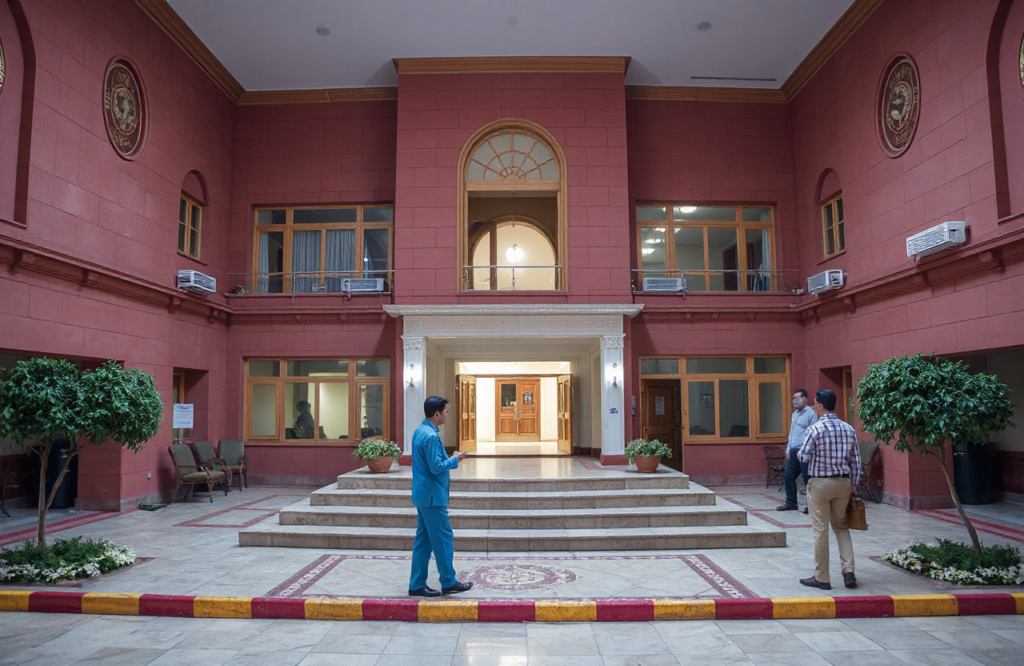
The investigation has intensified at Al-Falah Medical College, particularly concerning Room 13 in Building 17, which was reportedly used by the accused and others for planning and coordination of the alleged terror activities. The campus is now considered a significant operational base for this network.
Planning and Coordination Activities
Authorities suspect that the assistant professor and another doctor from Lucknow utilized Room 13 to strategize routes and transport ammonium nitrate for planned explosions throughout the Delhi-NCR region. Other doctors also frequented the room, indicating a broader network of involvement.
Campus Background and Student Observations
Established in 2014, the 72-acre Faridabad campus aims to provide affordable medical education to students from underprivileged backgrounds in regions such as Jammu and Kashmir, Uttar Pradesh, and Bihar. A nearby student remarked on the unusual activity around Room 13, noting that it was consistently closed and attracted unfamiliar visitors at odd hours.
Police Insights and Forensic Analysis
According to ACP (Crime) Varun Dahiya, Building 17 served as a command post for the group, with Room 13 functioning as a planning hub. The police have not ruled out the possibility of further connections within the campus, suggesting that other individuals may have unknowingly assisted the group.
Evidence Collection and Ongoing Investigation
Forensic experts are actively gathering samples of residue, fingerprints, and digital evidence from Room 13, along with chemical samples from a sealed laboratory on campus. All academic-related chemicals and solvents have been confiscated for detailed analysis.
Community Reactions
Building 17 has been entirely sealed, with police inspecting each room for hidden evidence. A resident doctor expressed surprise, stating that although the building was the busiest hostel, no one suspected that covert activities were ongoing in one of its rooms. The doctor in question was described as polite and studious, though there was an underlying sense that something was amiss about his behavior.