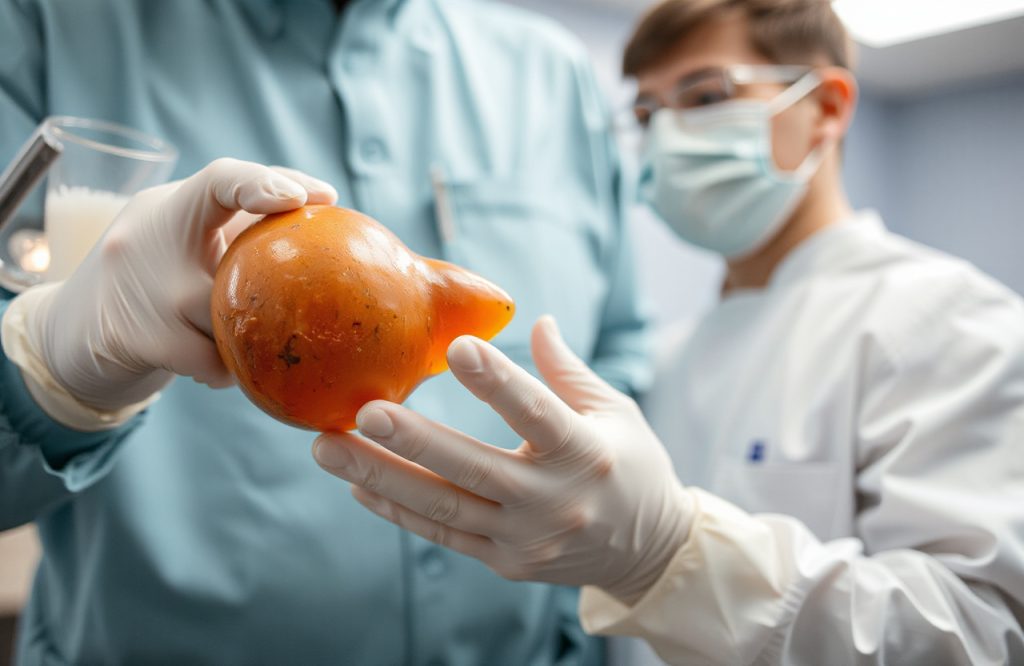
New Insights on Gallstone Formation
Understanding Gallstones
A recent article published in the journal Immunity has unveiled the mechanisms behind gallstone formation. Gallstones, known medically as cholelithiasis, are a significant cause of hospitalizations worldwide. Many people may know someone affected by this condition, or they might have heard of gallstones without fully understanding what they are. While it has been established for years that cholesterol and calcium crystals play a role in gallstone formation, the biological mechanisms underlying this process remained largely unclear until now. Researchers from Universitätsklinikum Erlangen in Germany have made significant strides in understanding how these stones form and grow, leading to potential new treatment options for individuals at risk.
What Are Gallstones?
Gallstones are solid particles that develop in the gallbladder, ranging in size from small grains of sand to larger formations comparable to golf balls. Bile, a greenish-yellow fluid essential for fat digestion, is produced in the liver and stored in the gallbladder. During digestion, bile is released into the small intestine through the bile duct. This fluid primarily consists of water, dissolved cholesterol, calcium, various salts, and bilirubin. When there is an excess of cholesterol and calcium in the bile, it can become supersaturated, leading to the formation of solid crystals—an initial step in gallstone development. This process can be likened to adding too much salt to water, where the salt eventually becomes visible as the solution reaches saturation. The formation of cholesterol and calcium salt crystals is the first step, but the question remains: what causes these crystals to aggregate into larger pebble-like structures?
Crystal Aggregation and Gallstone Formation
To explore the formation of gallstones, researchers at Universitätsklinikum Erlangen examined gallstones collected from adult surgical patients, as well as samples from the Charité hospital in Berlin and bile from healthy pigs. Utilizing advanced imaging techniques and experimental studies that induced gallstone formation in mice, the researchers discovered that all gallstones contained neutrophils with extracellular DNA. Neutrophils, a type of white blood cell, are activated by the body’s innate immune response to target foreign substances, including crystals. When a neutrophil attempts to engulf the crystals through a process called micropinocytosis, it eventually dies, releasing its DNA, which wraps around the crystals, forming a net-like structure. These structures, known as neutrophil extracellular traps (NETs), act as a “glue,” facilitating the aggregation of crystals into larger formations known as gallstones. Further investigations indicated that the activities of PADI4 and NOX2 are crucial for the immune response associated with neutrophil NET formation.
Implications for Prevention and Treatment
Understanding the mechanisms behind gallstone formation opens avenues for new pharmacological interventions. These treatments could address gallstone formation at various stages without requiring surgical intervention. For instance, the existing medication Metoprolol, commonly prescribed for high blood pressure, has already shown promise in reducing neutrophil activity and consequently NET formation. Researchers are now particularly interested in strategies that inhibit PAD14 or NOX2 activity to prevent NET formation altogether. Additionally, the findings may have broader implications for conditions such as kidney stones and salivary stones.
Conclusion
The recent research sheds light on the complex biological mechanisms involved in gallstone formation, presenting potential new strategies for prevention and treatment that could significantly benefit patients at risk.
References
Muñoz, L. E., Boeltz, S., Bilyy, R., Schauer, C., Mahajan, A., Widulin, N., … Herrmann, M. (2019). Neutrophil Extracellular Traps Initiate Gallstone Formation. Immunity, 51(3). doi: 10.1016/j.immuni.2019.07.002
Unlocking the Secrets Of Gallstones. FAU_Germany – https://www.eurekalert.org/pub_releases/2019-10/uoe-uts100819.php