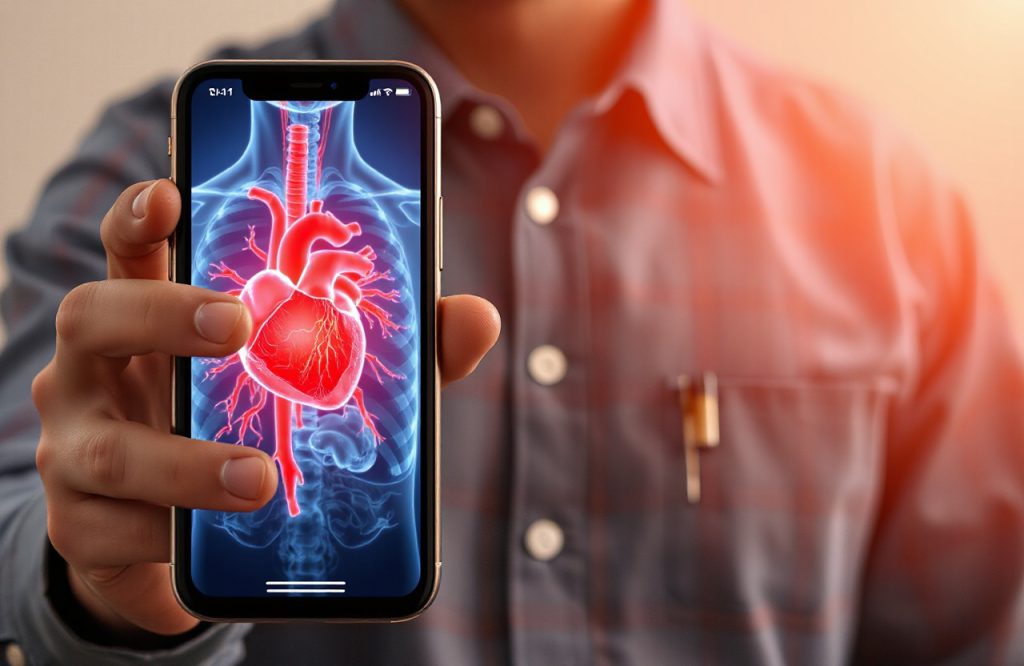
Smartphone App for Rapid Detection of Heart Attacks
Overview of Heart Disease
Heart disease remains the foremost cause of mortality globally, encompassing various conditions that impair the heart muscle’s function. This dysfunction can lead to plaque build-up in the arteries, heightening the risks of heart attack, stroke, or heart failure. A significant portion of heart disease-related deaths is attributed to heart attacks and strokes.
Understanding ST-Elevation Myocardial Infarctions
ST-elevation myocardial infarctions (STEMIs) represent a critical category of heart attacks and rank as the second leading cause of death in Canada, following cancer. STEMIs occur when a coronary artery, responsible for supplying blood to the heart, experiences a complete blockage. This obstruction damages the full thickness of the heart muscle, resulting in detectable changes on an electrocardiogram (ECG). The symptoms associated with STEMIs can be both severe and life-threatening.
The Importance of Early Detection and Treatment
Timely identification and treatment of STEMIs are vital to prevent fatalities. Accurate detection through an ECG facilitates appropriate diagnosis and intervention. Recent international research, spearheaded by the Intermountain Medical Heart Institute in Salt Lake City, Utah, indicates that a smartphone app can effectively monitor heart activity and identify STEMIs.
Study Methodology
The study examined 204 patients presenting with chest pain. Each participant underwent both a standard 12-lead ECG and an ECG using the AliveCor smartphone app. The standard 12-lead ECG involves 10 electrodes placed strategically on the body to capture 12 different perspectives of heart activity, while the AliveCor app employs a two-lead system that adjusts wire leads around the body to record all angles of heart activity.
Accuracy of the Smartphone App
Findings revealed at the American Heart Association’s 2018 Scientific Session in Chicago demonstrated that the app detects STEMIs with a high level of accuracy comparable to traditional 12-lead ECGs. Notably, the app did not produce false positives for heart attacks in patients who were not experiencing one.
Treatment Options for STEMI
STEMI heart attacks are commonly treated with percutaneous coronary intervention (PCI), a procedure that reopens blocked coronary arteries using a balloon or catheter. This intervention restores blood flow to the heart, and stents are often placed in obstructed arteries to maintain circulation. Research indicates a strong correlation between door-to-balloon time—the duration from patient admission to PCI—and the risk of in-hospital mortality. The American Heart Association recommends that this time should be under 90 minutes for STEMI patients to minimize the risk of fatal outcomes.
Enhancing the Treatment Process with Technology
The newly developed app has the potential to expedite the treatment process by swiftly identifying STEMIs. Some patients experiencing chest pain may hesitate to seek medical attention if they perceive their symptoms as mild, which can delay critical treatment. With the app, ECG data is transmitted directly to a cardiologist, who can confirm the STEMI diagnosis and prompt immediate treatment.
Accessibility of ECG Testing
This app also serves as a cost-effective alternative for ECG testing, enhancing accessibility for individuals in developing countries with limited healthcare resources. The study highlights the significant role of technology in addressing global healthcare challenges and reducing mortality from major diseases.
References
– Public Health Agency of Canada. Report from the Canadian Chronic Disease Surveillance System: heart disease in Canada, 2018.
– Nippak P, et al. Evaluation of a regional ST-elevation myocardial infarction primary percutaneous coronary intervention program at the Rogue Valley Health System. BMC Health Serv Res, 2014.
– Heart and Stroke Foundation of Canada. Heart attack.
– Intermountain Healthcare. Study finds phone app effectively identifies potentially fatal heart attacks with the near accuracy of a standard ECG.
– CorHealth Ontario. ST elevation myocardial infarction (STEMI).
– Swaminathan RV, et al. Non-system reasons for delay in door-to-balloon time and in-hospital mortality. J Am Coll Cardiol, 2013.