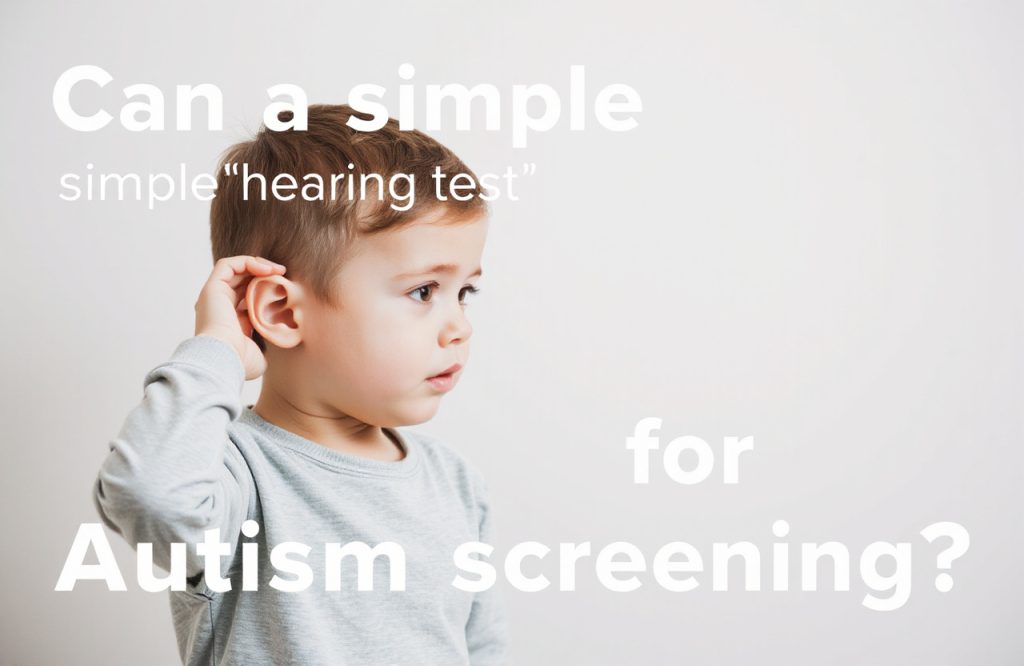
Study Explores the Link Between Hearing Impairment and Autism Screening
Overview of Autism Spectrum Disorders
An American study published in The Journal of the American Osteopathic Association investigates the potential of hearing impairment as a predictor of autistic behaviors, which could enhance autism screening methods. Autism spectrum disorders vary widely, with manifestations ranging from mild social discomfort to a complete absence of communication skills. Individuals with autism often exhibit repetitive behaviors that can significantly impact their daily lives. Furthermore, children on the autism spectrum frequently struggle to comprehend verbal and non-verbal cues from their peers, leading to social isolation and a decline in their social standing.
Current Autism Screening Methods
Currently, there are no laboratory tests available for autism screening. The medical community relies heavily on observational assessments of a child’s behavior and discussions with parents. This lack of diagnostic tools complicates the process for both the healthcare system and the families affected by autism, making it a challenging and exhaustive experience.
Hearing Dysfunction and Autism
Research has long suggested a connection between autistic disorders and hearing dysfunctions. A notable example is the heightened sensitivity to noise experienced by many individuals with autism, which may not disturb those without the condition. However, the exact mechanisms linking auditory processing and autism remain unclear. To clarify this relationship, American researchers conducted a comprehensive literature review alongside experimental studies focusing on auditory dysfunctions in relation to autistic disorders. Their findings were published in The Journal of the American Osteopathic Association.
Brain Functionality in Autistic Individuals
The study highlights that the brain region responsible for hearing is altered in individuals on the autism spectrum. This area contains fewer brain cells compared to those without autism, leading to distinct functional differences. Evidence suggests that auditory issues associated with autism may be present from birth and could potentially be detected at that early stage.
Insights from Dr. Randy Kulesza
In a press release, Dr. Randy Kulesza, PhD, a co-author of the study, emphasized that while many individuals with autism experience hearing issues, not all individuals with hearing impairments are autistic. The current screening practices often fail to detect autism until significant social or verbal challenges emerge, indicating that auditory testing may provide a valuable alternative.
Dr. Kulesza stated, “Often people with autism suffer from hypersensitivity, meaning even relatively quiet sounds can feel like overwhelming noise. If parents and physicians understand that from the start, they can work to acclimate the child’s sensitivity and make his or her experience of the world much less intense and frightening.”
Potential of Auditory Integration Training
The researchers also explored how auditory integration training may aid in normalizing brainstem responses and improving behaviors in children with autism. While auditory testing alone would not serve as a diagnostic tool, it may help identify children who require earlier autism screening. The proposed hearing tests are non-invasive and easy to administer, enabling doctors and parents to monitor a child’s condition from a very young age and facilitating timely intervention.
Conclusion
This study underscores the significance of understanding the interplay between auditory processing and autism. By integrating auditory assessments into routine screenings, healthcare providers may enhance early detection and intervention strategies for children on the autism spectrum.
Reference
Smith A, Storti S, Lukose R, Kulesza Jr R. Structural and Functional Aberrations of the Auditory Brainstem in Autism Spectrum Disorder. The Journal of the American Osteopathic Association. 2019;119(1):41.