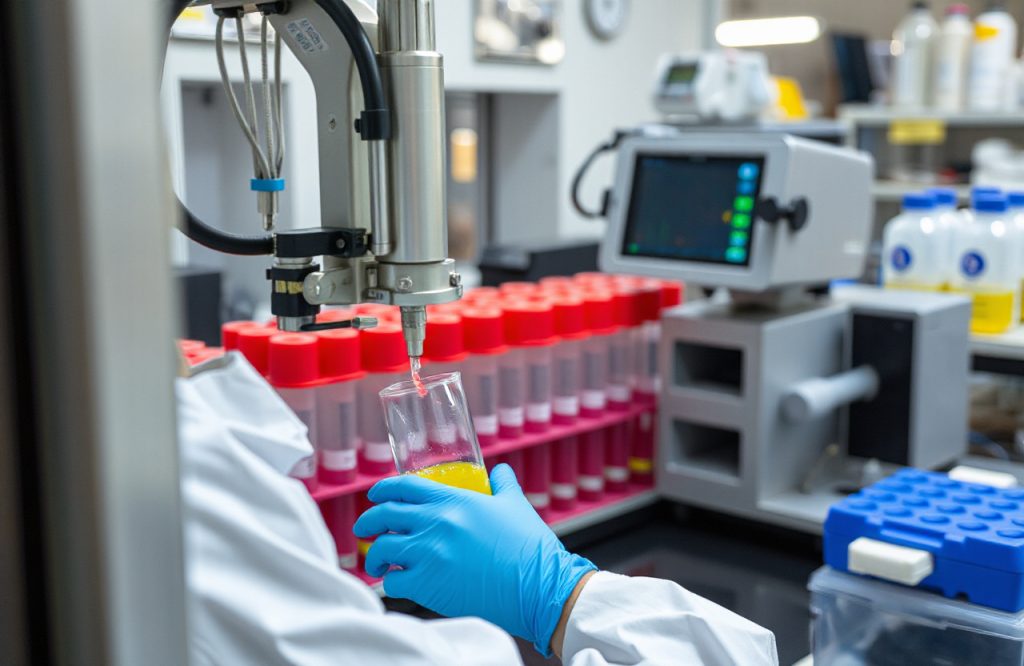
A Quiet Revolution in Diagnostics Labs
The Shift to Automation
In recent times, diagnostics labs are undergoing a significant transformation that has largely gone unnoticed by the general public. Imagine waiting for your test results, and instead of a technician manually handling your sample, it’s processed by a sophisticated system capable of measuring liquids with remarkable precision. This shift is not merely about replacing human workers; it aims to address challenges that manual methods have struggled to overcome for years.
The Limitations of Manual Methods
It’s essential to acknowledge the inherent limitations of human capabilities. Even the most skilled lab technician can have off days due to fatigue or distractions. After performing repetitive tasks, such as pipetting the same volume numerous times, attention may wane, leading to inconsistencies. In diagnostics, even slight variations can distort batch results, making it nearly impossible to maintain consistency across shifts.
The Advantages of Automated Systems
Consistency and Precision
Automated liquid handling systems have revolutionized the field by ensuring that consistency issues are completely resolved. These machines can dispense minuscule volumes with identical accuracy every single time, regardless of the time or day. The speed of automation is noticeable; a complex process that could take a skilled technician hours can be completed in mere minutes. However, the true benefit lies in reliability, especially when conducting sensitive assays where minor volume errors can significantly impact outcomes.
Practical Applications in Diagnostics
Automation has practical implications, particularly in scenarios like infectious disease testing during a pandemic. Automated platforms can manage entire workflows, from sample extraction to reagent addition, while maintaining correct temperatures and tracking samples, eliminating risks of mislabeling. In drug discovery, automation allows for the testing of thousands of compounds efficiently, and in cancer diagnostics, it facilitates the simultaneous analysis of multiple biomarkers.
Expanding Testing Capabilities
Overcoming Practical Limitations
Automation creates new possibilities for diagnostics that were previously impractical. For example, tests that require numerous liquid transfers per sample can now be performed without the prohibitive labor costs and error risks associated with manual methods. This development allows for comprehensive metabolic panels and intricate serial dilutions to be processed easily.
Streamlining Documentation Processes
One often-overlooked benefit of automation is the alleviation of documentation burdens. Automated systems log every action, providing a detailed record for investigations into unexpected results. In contrast, manual documentation can be prone to errors and inefficiencies. Additionally, automated systems reduce human contact with infectious samples, enhancing safety by minimizing contamination risks.
Challenges in Implementation
Navigating the Transition
Despite its advantages, implementing automation presents challenges. Transitioning from manual techniques to automated systems requires effort and trust in new technologies. There is a learning curve that can be frustrating, especially when redesigning methods and integrating new equipment into existing workflows.
Financial Considerations
The financial implications of automation are complex. While advanced systems can be expensive, it is crucial to consider labor savings, reduced reagent waste, and lower retesting costs when evaluating the overall value. Smaller labs can start with entry-level systems and gradually expand as budgets allow, making automation accessible to a broader range of facilities.
The Future of Automation in Diagnostics
Advancements on the Horizon
The field of automation is still evolving, with new systems becoming smarter and more integrated. Some utilize AI to optimize protocols based on real-time sample responses, while microfluidic platforms are condensing lab processes into compact chips. The goal is to achieve nearly full automation for routine testing, allowing for human oversight only when necessary.
The Role of Human Expertise
Importantly, automation does not render laboratory professionals obsolete. Instead, it enhances their roles by freeing them from repetitive tasks, allowing them to focus on method development, quality oversight, and complex problem-solving. This evolution requires technicians to possess a deeper understanding of both scientific principles and technological operations.
Beginning Your Automation Journey
Identifying Key Areas for Automation
For laboratories considering automation, it is vital to pinpoint areas of inefficiency. Determine which processes are time-consuming and contribute to variability. Start by automating one high-volume process to build experience before expanding further. Engaging with similar labs and learning from their experiences can also prove invaluable.
Planning for the Future
As labs evolve, selecting a flexible automation system capable of adapting to changing needs is crucial. The landscape of diagnostics is constantly shifting, and facilities must be prepared to accommodate new test menus, regulations, and sample volumes.
The Conclusion: Embracing Automation in Diagnostics
Automated liquid handling has transitioned from a luxury to an essential component of modern diagnostics. The precision and efficiency of these systems enable testing methods that were once unrealistic. While there are challenges in implementation and investment, labs that successfully integrate automation position themselves to meet the growing demands of healthcare, ensuring faster turnaround times, greater accuracy, and expanded capabilities. The pressing question for most diagnostic operations is no longer whether to automate, but how quickly they can do so effectively while maintaining quality standards.