Advancements in Treating Gynecological Cancers
New Findings from the University of Western Ontario
Scientists at the University of Western Ontario have recently unveiled a more precise method for treating gynecological cancers, utilizing modern technology to enhance treatment outcomes.
Understanding Vaginal Cancer
Vaginal cancer, a rare form of cancer that originates in the vagina, can present symptoms such as pain and unusual vaginal bleeding outside of menstrual cycles. Often, there are no apparent signs, and the cancer may only be detected during routine medical examinations. However, early diagnosis significantly increases the chances of successful treatment.
Interstitial Brachytherapy as a Treatment Option
One effective treatment for vaginal cancer is interstitial brachytherapy. This method involves administering a high dose of radiation directly into the tumor or its surrounding areas via thin needles under anesthesia. This approach is referred to as a high-dose-rate (HDR) transperineal interstitial technique.
Lack of Standard Visualization Methods
To minimize potential side effects to adjacent organs, such as the bladder and rectum, it is crucial to accurately position the radioactive implant within the tumor. Unfortunately, standard visualization methods for vaginal cancer therapy are currently inadequate. Clinicians can only verify the needle’s position using CT images after the procedure, making real-time adjustments impossible.
Development of a New Ultrasound System
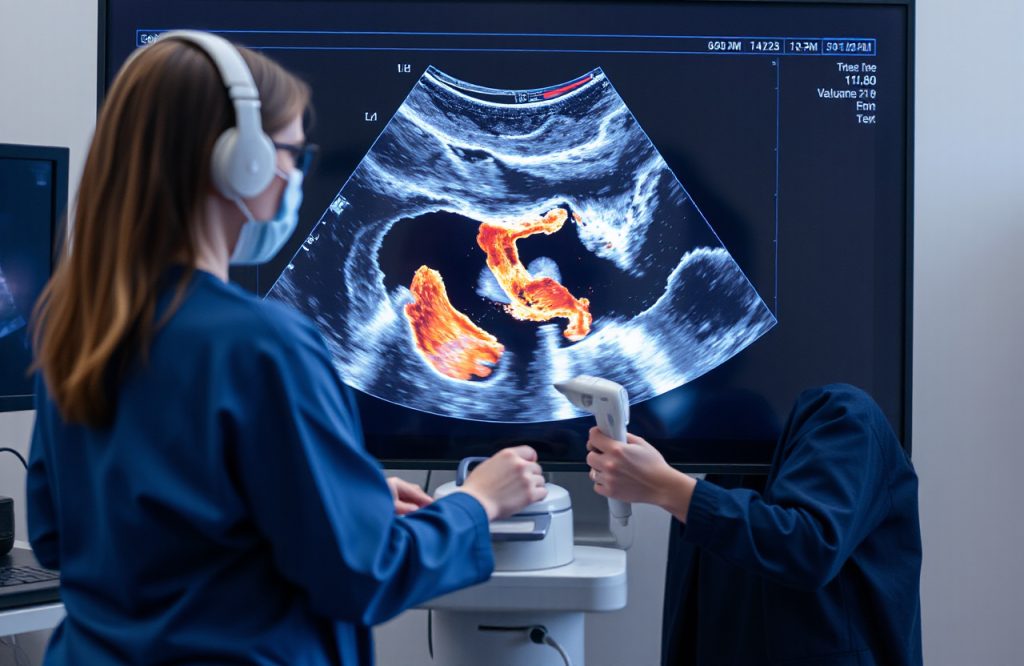
To address this challenge, researchers have developed an innovative ultrasound system, as detailed in the Journal of Medical Imaging. Their goal was to convert traditional 2D ultrasound images into 360-degree, 3D images, providing precise locations for vaginal cancer, nearby organs, and the positioning of needles during treatment.
Clinical Study and Results
The study involved six women with vaginal cancer at the London Health Science Centre in Canada. The new scanning method takes just 20 seconds and provides immediate results. To evaluate its accuracy, researchers compared the newly generated 3D images with standard post-treatment CT scans. The results indicate that the 360-degree, 3D ultrasound offers a clear and accurate depiction of all involved structures, including the rectum, catheter in the urethra, bladder, and vaginal wall.
Implications for Future Treatments
The findings from this study suggest promising prospects for the treatment of vaginal and uterine cancers. The accessibility and affordability of ultrasound technology, combined with live imaging capabilities, allow for real-time adjustments to needle placements during injections. This enhancement can improve treatment efficacy by ensuring precise radiation delivery to the cancer site while reducing radiation exposure to surrounding organs.
Future Research Directions
Despite these encouraging results, further studies with larger patient populations are necessary to evaluate the effectiveness of this new imaging technique and to assess minor adjustments in needle positioning across different imaging modalities. Currently, the system’s application is limited to the lower part of the vagina.
To extend the visualization capabilities to the uterus and improve radiotherapy for gynecological tumors such as uterine cancer, the research team is conducting additional studies using the same ultrasound system.
Correction Notice
An earlier version of this article inaccurately described interstitial brachytherapy as “a type of radiotherapy in which a doctor injects a high dose of drugs.” The correct description is that it involves “a type of radiotherapy in which a doctor injects a high dose of radiation.” This correction was made on May 17, 2019.
References
Rodgers, J. and Bax, J. (2019). Intraoperative 360-deg three-dimensional transvaginal ultrasound during needle insertions for high-dose-rate transperineal interstitial gynecologic brachytherapy of vaginal tumors. Journal of Medical Imaging, 6(02), p.1. cancer.ca. (2019). Symptoms of vaginal cancer – Canadian Cancer Society. [online] Available at: https://www.cancer.ca/en/cancer-information/cancer-type/vaginal/signs-and-symptoms/?region=on [Accessed 6 May 2019].
Photo credit: Schulich Medicine & Dentistry, Western University.