Advancements in Parkinson’s Disease Therapy
Understanding Parkinson’s Disease
A key characteristic of progressing Parkinson’s disease is a unique shuffling gait. This condition affects nearly 500,000 Americans, making it the second-most prevalent neurodegenerative disorder after Alzheimer’s. The disease disrupts the functioning of dopamine-producing neurons in the substantia nigra, an area of the brain responsible for controlling physical function. As these neurons malfunction or die, the brain struggles to relay movement signals to the body, leading to impaired motion and mobility challenges.
Mobility Challenges in Parkinson’s Disease
Individuals with Parkinson’s often experience symptoms such as balance loss, shuffling gait, difficulty swinging their arms, and “freezing” during movement. These issues can intensify when attempting to multitask, such as walking while engaging in conversation. Researchers, including Jay Alberts from the Cleveland Clinic, prioritize finding solutions that enhance mobility and independence for people living with Parkinson’s.
Augmented Reality as a Therapeutic Tool
Dual-task training (DTT) is a method used to address gait issues in Parkinson’s disease by requiring patients to manage multiple tasks simultaneously. This training typically occurs in one-on-one sessions with a physical therapist who customizes a program, guides the exercises, and monitors progress. While effective in improving posture and balance, DTT is often underutilized due to its cost and time demands. Innovations in augmented reality (AR) inspired researchers like Drs. Jay Alberts and Anson Rosenfeldt to explore new ways to broaden access to DTT.
Innovative Research Findings
Study Overview
A recent clinical trial published in Neurorehabilitation and Neural Repair assessed the efficacy of augmented reality headsets in providing virtual dual-task training. The study involved 47 participants with gait issues related to Parkinson’s, who were divided into two groups: one received traditional DTT sessions with a therapist, while the other engaged in Dual-Task Augmented Reality Treatment (DART). Both groups completed 16 therapeutic sessions over eight weeks.
Implementation of the DART Program
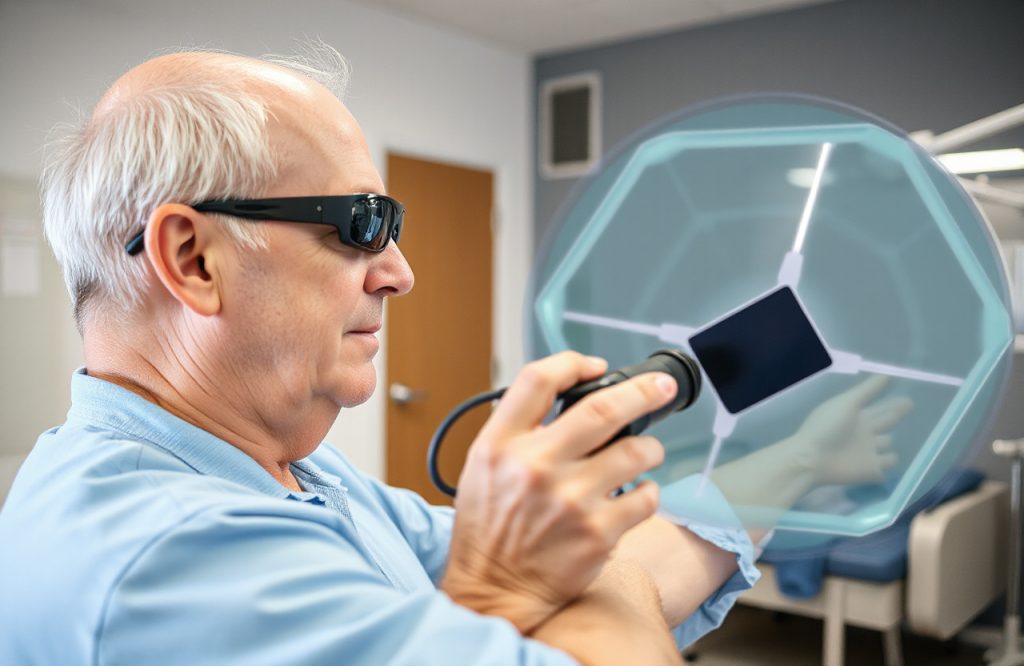
In the DART program, users wear an AR headset that displays an avatar named Donna, who demonstrates the exercises. As participants follow along, the headset tracks their movements and collects data for clinical assessment. The program can generate over 200 combinations of dual-task exercises, enhancing the training experience.
Results and Conclusions
Both groups exhibited significant improvements in walking ability following the therapy. Jay Alberts noted, “The trial shows that using an AR headset or physical therapist directed DTT produces similar improvements in gait and postural stability.” This suggests that AR technology may offer a viable alternative to traditional therapy methods.
Augmented Reality as an Accessible Tool
The authors emphasize that DART is not intended to replace physical therapists but rather to supplement their efforts, making DTT more accessible to patients. Alberts remarked, “Our goal is to make DTT more accessible, removing one more obstacle for patients who want to improve their daily lives.”
References
– Alberts JL, Kaya RD, Penko AL, et al. A Randomized Clinical Trial to Evaluate a Digital Therapeutic to Enhance Gait Function in Individuals With Parkinson’s Disease. Neurorehabil Neural Repair. 2023;37(9):603-616. doi:10.1177/15459683231184190
– Using augmented reality to make Parkinson’s disease physical therapy more accessible. EurekAlert! Accessed March 13, 2024.
– Parkinson’s Disease: Challenges, Progress, and Promise | National Institute of Neurological Disorders and Stroke. Accessed March 14, 2024.
– Zheng Y, Meng Z, Zhi X, Liang Z. Dual-task training to improve cognitive impairment and walking function in Parkinson’s disease patients: A brief review. Sports Medicine and Health Science. 2021;3(4):202-206. doi:10.1016/j.smhs.2021.10.003