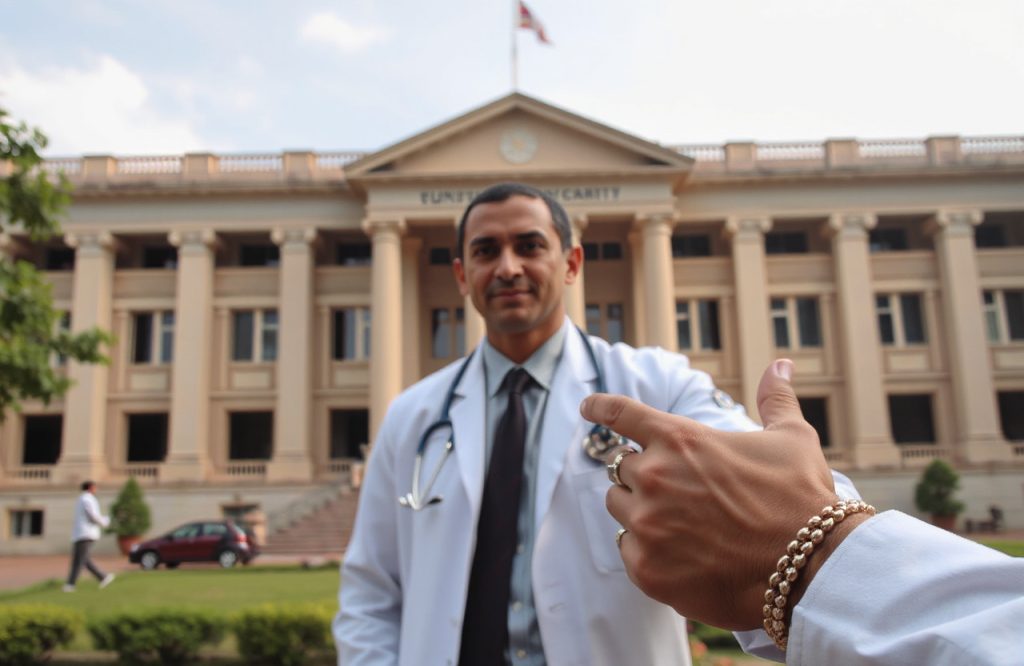
Supreme Court Allows Young Doctor to Apologize for Exam Misconduct
Background of the Case
New Delhi: The Supreme Court has granted permission for a young doctor to submit an unconditional apology to his medical college for wearing a digital watch during an examination. This decision came after the court considered an appeal from the doctor’s father, highlighting the impact of the situation on the young professional’s career.
Court’s Observations
The Supreme Court bench, comprising Chief Justice Surya Kant and Justice Joymalya Bagchi, expressed that the young doctor’s nine-year professional hiatus was “a more than sufficient punishment” considering the nature of the incident. They noted that any additional obstruction to his career would be “too harsh and disproportionate.” The bench remarked, “At the end of the day, there is a father standing in court with folded hands, trying to save the academic career of his son.”
Original Incident and Legal Battle
The case dates back to February 2017, when the student was found wearing a digital wristwatch during an exam at Sri Ramachandra Medical College in Chennai. Under the university’s strict “unfair means” policy, his exam was canceled. While he subsequently passed the courses, the incident continued to overshadow his academic record, prompting a prolonged legal battle that included unsuccessful appeals in both the High Court and the Supreme Court.
Claims of Conspiracy
In a recent media report from Verdictum, the student’s father appeared in court, alleging a conspiracy involving “polluted counsels” and “fabricated documents.” He accused the Bar Council of India of failing to investigate claims of fraud by legal representatives who allegedly withdrew the petitions without proper consent.
Court’s Directive
The Court acknowledged that Sri Ramachandra Medical College had not been summoned at this stage to avoid imposing litigation costs, especially as the order would not adversely affect the college’s operations. The Court urged the petitioners to submit an unconditional apology to the university and seek the expungement of adverse remarks from the young doctor’s marksheet. They requested the medical college to review the representation with “utmost sympathy” to aid in preserving the doctor’s professional future.
Humanitarian Approach
While refraining from reassessing the merits of the original 2017 disqualification or the dismissed curative petition, the Court emphasized a humanitarian resolution. It noted that the extensive duration of the struggle—a nine-year barrier to a medical career—had become a punishment that far exceeded the severity of the original infraction.
Conclusion
In conclusion, the Court directed the petitioners to offer an unconditional apology and requested the university to consider expunging the adverse remarks. The focus was placed on prioritizing the future of the young professional over the technicalities of past misconduct. The Court observed that the prolonged impact of the situation warranted a compassionate response to prevent further hindrance to the doctor’s career. With this, the Court disposed of the matter.