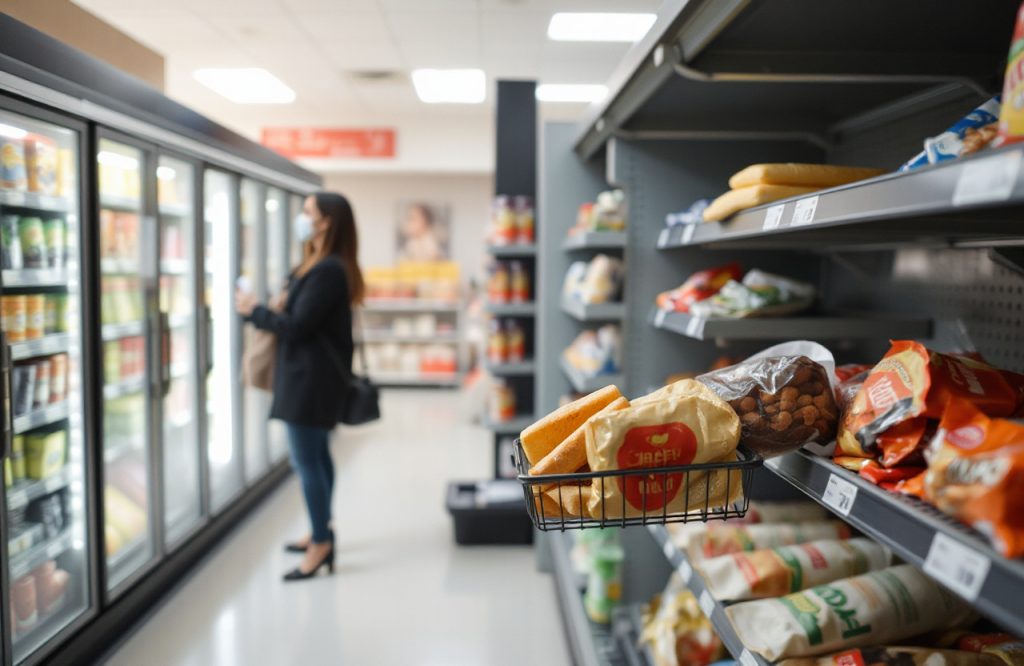
Impact of Supermarket Checkout Food Policies on Unhealthy Snack Sales
Understanding Impulse Purchases
It is common for shoppers to make impulse buys while waiting in line at supermarkets, with a recent survey indicating that 70.5% of these impulse purchases are food items, many of which are unhealthy snacks. Supermarkets significantly influence customer purchasing behavior and allocate substantial budgets for optimal product placement.
Healthier Checkout Options in the UK
In response to growing health concerns, numerous supermarkets in the UK have voluntarily committed to stocking healthier food options at checkout and have established checkout food policies to uphold these commitments. A study published in PLoS Medicine examined the connection between these policies and the sales of unhealthy snacks.
Study Methodology
Researchers analyzed data from a UK commercial household purchase panel to investigate whether supermarkets with checkout food policies sold fewer unhealthy snacks compared to those without such policies. The study focused on nine supermarkets that accounted for over 90% of the UK grocery market. Among these, six altered their checkout food policies between January 2014 and July 2016, while two had implemented policies before January 2013, and one had no policy at all.
Classification of Checkout Food Policies
To assess the checkout food policies, researchers categorized supermarkets into three groups:
1. Clear and consistent policies, which specified the replacement of sweets and chocolates with healthier alternatives.
2. Vague or inconsistent policies, which either limited the number of unhealthy snacks per checkout or failed to provide replacement guidance.
3. No policy.
Unhealthy snacks included items such as sweets, chocolates, and potato chips.
Analysis of Purchases
The study included an analysis of foods brought home, utilizing consumer panel data from 30,000 UK households since 2013, representing a total market of 27,385,050 households. Researchers compared the purchases of checkout foods in the year prior to the implementation of checkout food policies with those in the year following.
Results: Decreased Purchases of Unhealthy Snacks
Four weeks post-implementation of the checkout food policy, purchases of unhealthy snacks dropped by 17.3%. One year later, this figure was 15.5% lower compared to what might have occurred without the policy.
Unhealthy Snacks Consumed On-the-Go
The study also examined unhealthy snacks consumed outside the home, utilizing data from 7,500 individuals collected in 2016-2017, representing 50,398,000 UK individuals aged 13-79. Researchers compared the type of checkout food policy with the purchases of foods commonly consumed on-the-go.
The findings revealed a 79.5% reduction in unhealthy snacks purchased per year at supermarkets with clear and consistent checkout food policies. Those with vague or inconsistent policies saw a 75.3% reduction during the same period.
Influence of Product Placement on Consumer Choices
While the study focused solely on UK households, variations in retail practices across different countries may yield different results. Limitations of the study include potential selective movement of shoppers due to checkout food policies and variations in product selection within stores.
The evidence suggests that product placement decisions in supermarkets significantly impact customer choices. Further research into supermarket-led interventions and their motivations can enhance understanding of improving public health. Implementing checkout food policies may serve as an effective strategy to reduce unhealthy snack consumption and promote healthier food options.
References
Ejlerskov K, Sharp S, Stead M, Adamson A, White M, Adams J. Supermarket policies on less-healthy food at checkouts: Natural experimental evaluation using interrupted time series analyses of purchases. PLoS Med. 2018;15(12):e1002712. doi:10.1371/journal.pmed.1002712
O’Brien S. Consumers waste $5,400 a year on impulse buys. CNBC. https://www.cnbc.com/2018/02/23/consumers-cough-up-5400-a-year-on-impulse-purchases.html. Published 2018. Accessed December 28, 2018.