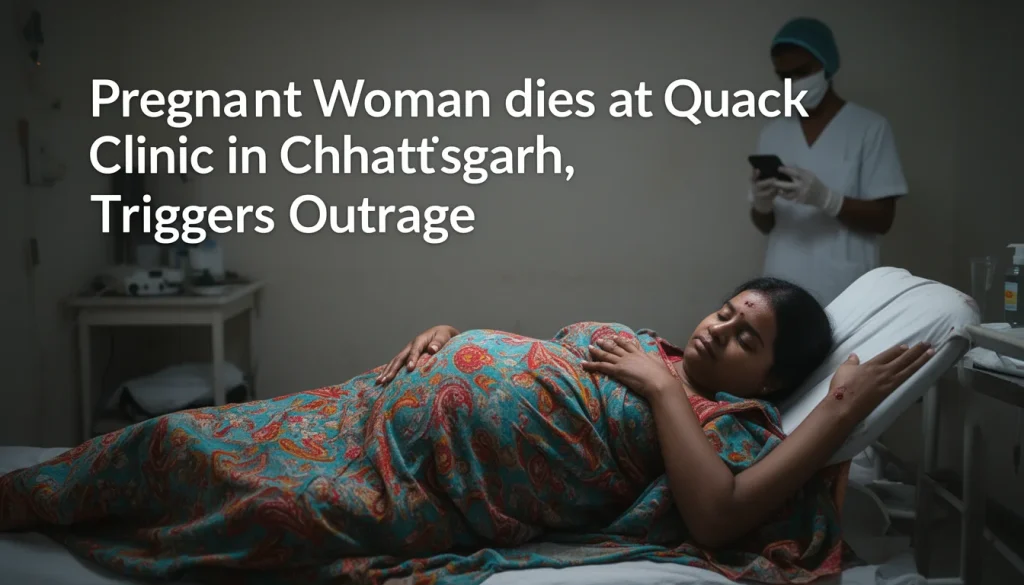
Pregnant Woman Dies at Unqualified Practitioner’s Clinic in Balodabazar
Summary of the incident
A 26-year-old woman who was four months pregnant died under suspicious circumstances at the clinic of an unqualified practitioner in Chhattisgarh’s Balodabazar district. The woman, married in 2022 and mother to a two-year-old son, had visited the practitioner’s clinic in Chherkadih Jara village seeking treatment for a cold and cough. Her death has reignited public concern about the practice of unqualified medical practitioners—commonly referred to as “quacks”—operating in rural areas.
Timeline of events
According to accounts from family members and local residents, the sequence was as follows:
– On Thursday, the woman first walked to the practitioner’s clinic but returned when he was not present. The practitioner also serves as the village sarpanch.
– After learning he had returned, she went back to the clinic. The practitioner checked her blood pressure and diagnosed her with a cold, cough and chest pain, saying he could not offer extensive treatment because she had not eaten.
– She remained at the clinic for approximately 15–20 minutes. During that period, her condition reportedly deteriorated: she began vomiting and then lost consciousness shortly after receiving an injection.
– The practitioner stated he gave her water, after which she briefly regained consciousness but collapsed again. She was subsequently taken to the Community Health Centre (CHC) in Palaria.
Medical observations at the CHC
Officials at the CHC reported that the woman was already dead on arrival. Dr. Pankaj Verma, the Block Medical Officer, observed blood and froth coming from her nose—signs described by the medical officer as indicative of a severe acute medical event. He confirmed that the accused practitioner was present when the body was brought to the facility.
Hospital staff at Palaria CHC reported that the body arrived at about 2 pm and that the family remained at the hospital for roughly four hours discussing the circumstances. Around 6 pm, the family submitted a written application refusing a postmortem, and the body was released to them thereafter.
Legal and administrative status
As of the latest reports, no formal police complaint has been filed at the Palaria police station, and no First Information Report (FIR) has been registered. The practitioner has reportedly admitted publicly that he does not possess a medical degree and has been treating patients for nearly 17 years without formal qualifications.
Family accounts and local reaction
The woman’s mother-in-law said that when the patient did not return home, she went to the clinic and found her daughter-in-law lying unconscious on her husband’s lap. She described the scene as shocking and terrifying and alleged that the unqualified practitioner’s treatment led directly to the death. Local residents voiced outrage at the incident and raised concerns about how unqualified individuals continue to provide medical care in villages.
Context: Quackery and access gaps in rural healthcare
Why unqualified practitioners operate freely
Local residents and community sources attribute the widespread presence of unqualified practitioners to structural gaps in rural healthcare: a shortage of formally trained MBBS doctors, long distances to functional health centres, and overall deficiencies in service delivery. In many villages, these practitioners are the first point of contact for minor illnesses despite lacking formal training or certifications. The present case highlights the risks patients face when complex or acute problems are handled outside the regulated healthcare system.
Past incidents in the region
This death is part of a pattern of incidents in the state involving unqualified practitioners. Recent years have seen multiple deaths linked to such practitioners in Chhattisgarh. Reported examples include:
– A young man in the Balod district who allegedly died after receiving multiple injections from an unqualified practitioner for haemorrhoids, which resulted in severe complications.
– A case in Janjgir-Champa where a self-styled practitioner was sentenced to seven years in jail following the death of a pregnant woman after an allegedly improper injection.
These earlier cases demonstrate that fatal outcomes associated with unregulated practice are not isolated and have, in some instances, led to criminal prosecution.
Implications and next steps
Questions for authorities and community safeguards
The incident raises several critical questions for health administrators, law enforcement and community leaders:
– How will local and district health authorities respond to the admission that an individual without medical qualifications has been treating patients for nearly two decades?
– What mechanisms can be strengthened to ensure timely reporting of suspicious deaths and to encourage families to allow postmortems when necessary for forensic and public-health evaluation?
– What interim measures can be implemented in rural areas to reduce reliance on unqualified practitioners—such as improved staffing of CHCs, mobile medical units, telemedicine support, or better community outreach?
Reporting and accountability
The family’s refusal of a postmortem and the absence, to date, of a formal police complaint mean that investigative and legal processes are not yet underway publicly. Given the practitioner’s admission of lacking medical credentials and his long-term practice in the village, the case is likely to invite scrutiny from district health officials and law enforcement. Public demand for accountability has already been expressed locally, and the matter will likely prompt renewed calls for stricter enforcement of regulations related to medical practice in rural communities.
Conclusion
The death of the 26-year-old pregnant woman in Balodabazar again underscores the hazards posed by unqualified medical practice in rural India. It also highlights persistent systemic challenges—staff shortages, accessibility gaps and weak enforcement—that allow such practices to persist. The immediate factual record includes the patient’s rapid deterioration after an injection at the clinic, the observations of CHC medical staff, the practitioner’s admission of no formal medical degree and the family’s refusal of a postmortem. These established facts form the basis for urgent community, administrative and legal attention to prevent further tragedies. medichelpline will continue to monitor developments as authorities and the family determine next steps.