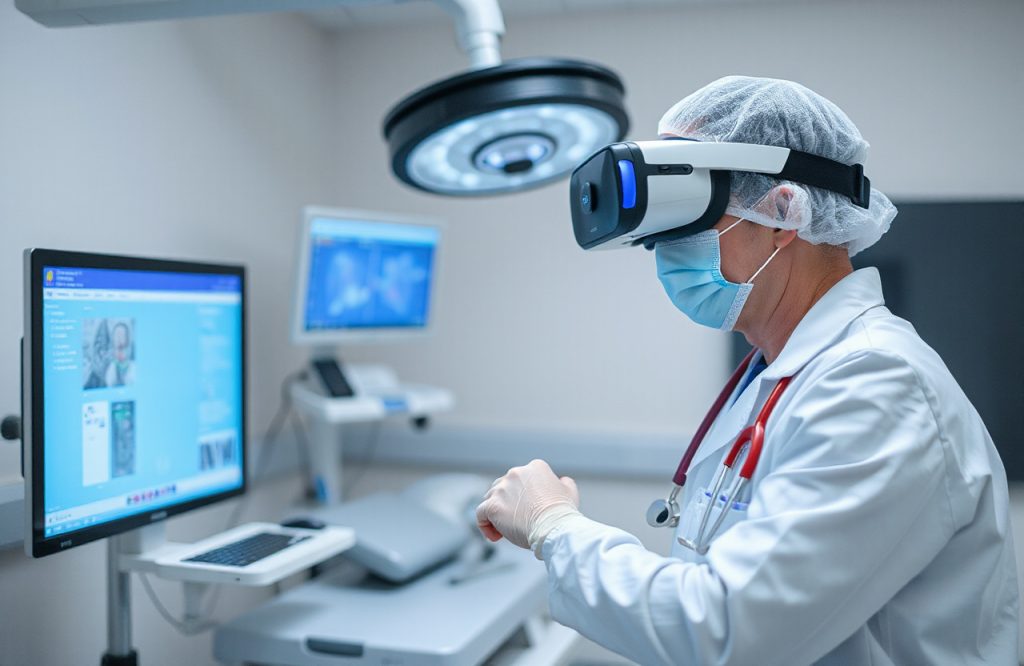
Innovative Uses of Virtual Reality in Research and Medicine
Assistive Technology for Low Vision
Retinitis pigmentosa is a progressive eye disorder that diminishes vision, particularly impairing peripheral sight and the ability to gauge relative distance. This visual impairment can significantly affect quality of life and hinder daily activities. Traditionally, individuals with this condition rely on aids such as canes or seeing-eye dogs for navigation. While virtual reality vision aids have been explored, their commercialization has faced challenges due to usability issues and interference with remaining vision.
A recent study published in *Nature* introduced augmented reality glasses as a potential assistive technology for individuals with low vision. The device, known as Microsoft Hololens, was tested in conjunction with the Microsoft Mixed Reality Toolkit (MMRT). This augmented reality tool was specifically designed to aid patients suffering from retinitis pigmentosa. A cohort of ten patients utilized the device to assist with mobility and obstacle avoidance.
The augmented reality glasses enhanced the users’ vision by projecting bright colors that corresponded to obstacles directly onto their retina. Researchers documented the patients’ experiences as they navigated through an obstacle course, noting any collisions and measuring the time taken to complete the course.
The findings indicated that patients reported improved vision while using the augmented reality glasses. Notably, mobility increased by 50%, and the ability to grasp nearby objects improved by 70%. However, the time taken to complete the course did not show significant change. Given that patients with retinitis pigmentosa face challenges in low-light conditions, this device effectively improved their vision under such circumstances.
Researchers acknowledged that while the augmented reality glasses showed promise, further testing is needed to address technical challenges before commercial implementation can occur. This study is noteworthy as it reportedly marks the first instance of vision enhancement in retinitis pigmentosa patients through an augmented reality aid in a Food and Drug Administration validated experiment.
Using Virtual Reality to Combat Loneliness
Aging brings physiological changes that can affect speed, accuracy, strength, stability, and coordination. The degree of these changes varies among individuals, and the specific alterations in brain or body functions remain largely unclear. As older adults engage in both motor and cognitive tasks, they tend to perform less effectively than younger individuals, which can limit their social interactions and lead to feelings of loneliness.
In today’s fast-paced, technology-driven society, feelings of isolation among the elderly are more pronounced. Many older adults did not grow up with television, and the rapid advancement of technology throughout their lives can make them hesitant to embrace modern digital communication methods.
Encouraging older adults to engage with contemporary technology is essential for mitigating loneliness. Research has shown that offering computer classes to seniors can significantly reduce feelings of isolation and enhance mental well-being. These classes emphasize online engagement, and with the evolution of technology, older adults can potentially overcome the barriers posed by their physical limitations.
Researchers, including Antunes and colleagues, aim to explore the additional benefits of incorporating virtual reality into computer classes for elderly participants. This accessible form of augmented reality could provide older adults with an enjoyable diversion from the natural decline associated with aging. Furthermore, it offers valuable insights into age-related changes through various game offerings.
The potential role of virtual reality in combating loneliness and promoting social interaction among the elderly presents an exciting opportunity. This area of research could play a crucial role in improving the quality of life for aging populations and alleviating some of the expected pressures on the healthcare system.
References
Angelopoulos, A.N., Ameri, H., Mitra, D. et al. Enhanced Depth Navigation Through Augmented Reality Depth Mapping in Patients with Low Vision. Sci Rep 9, 11230 (2019) doi:10.1038/s41598-019-47397-w
Keckmedusc. (n.d.). Augmented reality glasses may help people with low vision better navigate their environment. Retrieved from https://www.eurekalert.org/pub_releases/2019-08/uosc-arg082219.php
Image by Pexels from Pixabay